Top Safety Features Every Electric Forklift Should Have
Introduction
Electric forklifts have become essential assets in modern warehouses, distribution centers, manufacturing plants, and logistics operations. Their quiet operation, zero-emission performance, and lower maintenance demands make them a smart investment for businesses focused on efficiency and sustainability. However, the same qualities that make electric forklifts so valuable can also introduce serious safety concerns if the machine lacks the right protective systems. A quiet forklift can approach pedestrians with little warning. A powerful lift system can create dangerous instability when loads are handled incorrectly. A busy warehouse aisle can become a high-risk zone when visibility, speed, and operator awareness are not properly managed.
Choosing the right electric forklift is therefore not only a question of capacity, battery type, or price. It is a decision that directly affects operator safety, warehouse productivity, accident prevention, and long-term cost control. The best machines combine strong lifting performance with intelligent safety technology designed to protect people, products, and infrastructure. This guide explores the top safety features every electric forklift should have, including operator presence systems, speed control, load stability technology, braking systems, pedestrian alerts, visibility enhancements, telematics, diagnostics, and ergonomic design. For warehouse managers, logistics leaders, operations teams, and equipment buyers, these features are not optional upgrades. They are the foundation of a safer, more reliable material handling operation.
Operator Presence Systems That Prevent Uncontrolled Movement
Every safe electric forklift begins with one basic requirement: the machine should only operate when the operator is properly seated, positioned, and in control. In a fast-moving warehouse, operators frequently enter and exit forklifts to inspect loads, scan inventory, check pallet labels, or communicate with dock personnel. The problem arises when a machine remains active during these moments. If the operator steps away while the drive system, hydraulic controls, or travel functions remain enabled, the forklift can move unexpectedly or allow the mast to operate without full control. This creates a serious risk to nearby pedestrians, stacked inventory, racking systems, and the operator themselves.
Operator presence systems solve this problem by using sensors to confirm that the driver is in the correct operating position before the forklift can travel or lift. In many electric forklifts, a seat switch or presence sensor disables drive functions when the operator leaves the seat. Some machines also integrate seat belt monitoring, parking brake interlocks, and control lockouts that prevent the mast or travel system from activating unless all safety conditions are met. These systems are especially important in facilities where multiple operators share equipment across shifts, because they create a consistent safety baseline regardless of experience level.
The business impact is immediate and measurable. By preventing uncontrolled movement, operator presence systems reduce the likelihood of struck-by incidents, product damage, and equipment collisions. They also support better compliance with internal safety policies by making safe operation part of the machine’s normal workflow rather than relying only on operator memory. For warehouse managers, this means fewer avoidable incidents, less downtime, and greater confidence that every forklift is being operated under controlled conditions. Once the operator is confirmed to be properly positioned, the next major safety concern is how quickly the machine moves through the facility.
Intelligent Speed Control for Safer Warehouse Navigation
Speed is one of the most important factors in forklift safety. Electric forklifts deliver smooth, instant torque, which helps operators move pallets efficiently through docks, aisles, and staging areas. That same quick response can become dangerous when a machine accelerates too aggressively in tight spaces or travels too fast around blind corners. Warehouses are rarely static environments. Pedestrians cross travel lanes, pallets shift throughout the day, dock doors open and close, and other machines move in overlapping paths. Without proper speed control, even a highly skilled operator may struggle to react quickly enough to avoid an accident.
Intelligent speed control systems help reduce this risk by limiting travel speed based on operating conditions. Some electric forklifts allow managers to set maximum speed profiles for specific operators, work zones, or applications. More advanced systems can automatically reduce speed when the mast is raised, when the steering angle increases, or when the forklift enters a designated slow-speed area. This matters because the stability and stopping distance of a forklift change dramatically depending on load height, floor condition, turning angle, and travel direction.
The real value of speed control is that it protects safety without sacrificing productivity. Instead of relying on blanket speed restrictions that slow every task, intelligent systems allow the forklift to operate efficiently where conditions are open and controlled, then automatically become more cautious where risk increases. This reduces the chance of collisions with pedestrians, racks, dock equipment, and other forklifts. It also helps protect inventory from sudden stops and sharp turns that can cause pallets to shift or fall. For logistics leaders, intelligent speed control creates a more predictable traffic environment, which improves warehouse awareness and reduces the hidden costs associated with accidents, repairs, and insurance claims. As speed becomes more controlled, the next safety priority is ensuring the load itself remains stable during lifting and travel.
Load Stability Technology for Safer Lifting and Handling
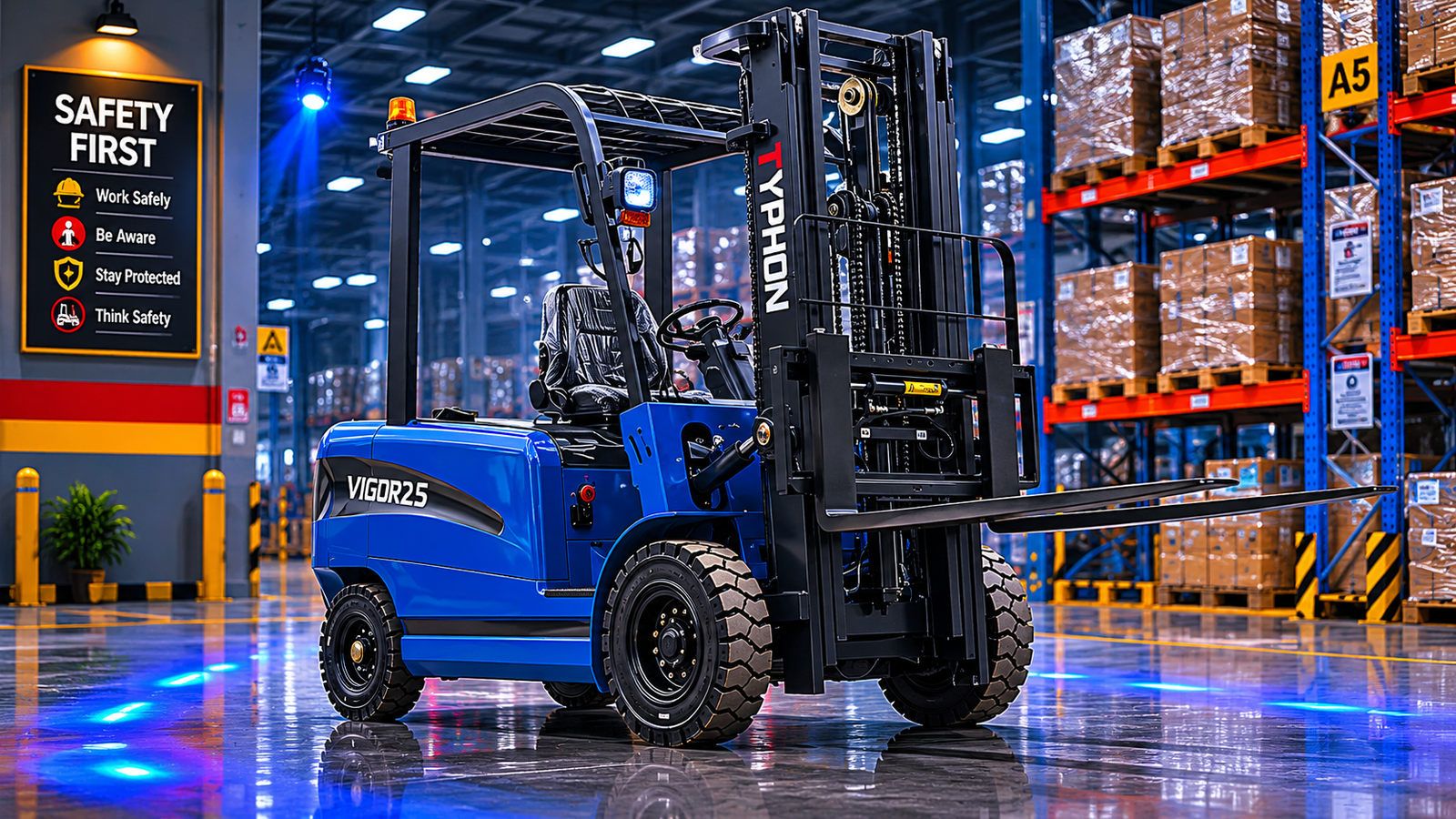
The central purpose of a forklift is to lift, carry, and place heavy loads. Yet load handling is also one of the most common sources of serious forklift accidents. Electric forklifts rely on a carefully balanced relationship between the machine’s counterweight, load center, mast angle, lift height, and travel speed. When operators exceed rated capacity, raise loads too high while traveling, tilt the mast incorrectly, or handle unstable pallets, the forklift’s center of gravity can shift beyond safe limits. This creates the risk of forward tip-overs, falling loads, rack impacts, and severe injuries.
Load stability technology helps operators stay within safe operating limits by monitoring key machine conditions during lifting and travel. Some electric forklifts include load weight indicators that show whether the machine is approaching or exceeding its rated capacity. Others use stability assist systems that limit certain functions when the load is elevated or when operating conditions become unsafe. Mast tilt controls, lift height sensors, and automatic speed reduction systems all contribute to safer load handling by reducing the risk of sudden instability. In high-density warehouses, where operators place pallets on elevated racks throughout long shifts, these technologies provide a critical layer of protection.
The business impact extends far beyond accident prevention. Stable load handling protects inventory from drops, crushing damage, and misplacement. It also protects racking systems, which can be costly to repair and dangerous if struck or weakened. When operators have access to clear load information and automated stability support, they make better decisions in real time. This leads to smoother pallet placement, fewer near-misses, and greater confidence during demanding lift cycles. For equipment buyers, load stability technology should be viewed as a long-term investment in uptime, product protection, and operator safety. Once a load is stable, the operator still needs clear visibility to move it safely through the warehouse.
Visibility Enhancements That Improve Operator Awareness
Visibility is one of the most practical and important safety features on any electric forklift. Warehouses are full of visual obstacles, including tall pallet stacks, storage racks, dock doors, shrink-wrapped loads, support columns, and moving personnel. Operators often need to travel in reverse, maneuver around tight corners, and place loads at height while maintaining awareness of both the forks and the surrounding environment. The problem is that traditional forklift design can create blind spots around the mast, overhead guard, rear counterweight, and load itself. When visibility is limited, operators must rely heavily on experience and caution, which may not be enough in a busy facility.
Modern visibility enhancements help solve this challenge by improving sightlines and adding visual support where the operator needs it most. A well-designed electric forklift should include a clear-view mast that reduces obstruction between the operator and the forks. High-quality LED work lights improve visibility in dim aisles, trailers, loading docks, and early-morning or late-night shifts. Rearview mirrors, panoramic mirrors, and camera systems can help operators monitor blind spots during reverse travel and tight maneuvers. In some applications, fork-mounted cameras or height-positioning systems provide additional precision when placing pallets on high racks.
These features directly improve warehouse awareness and reduce the risk of collisions, load damage, and operator fatigue. When operators can clearly see fork tips, pallet openings, pedestrians, and surrounding structures, they work with greater precision and less hesitation. This improves both safety and productivity because operators spend less time correcting poor approaches or repositioning loads. Better visibility also supports new or less experienced operators by giving them a clearer understanding of machine position and load alignment. For warehouse managers, improved visibility means fewer damaged pallets, fewer rack strikes, and a safer traffic flow throughout the facility. Still, even with excellent visibility, every forklift must be able to stop with complete reliability.
Advanced Braking Systems for Controlled Stopping Power
A forklift’s ability to stop safely is just as important as its ability to lift and travel. Electric forklifts often operate in areas where people, products, and equipment are only a few feet apart. A delayed stop near a dock edge, pedestrian crossing, rack upright, or trailer entrance can quickly become a serious incident. The challenge is that forklifts carry heavy loads that dramatically affect stopping distance. Floor conditions, tire wear, travel speed, battery weight, and load position all influence how quickly the machine can come to a controlled stop.
Advanced braking systems address this risk by combining mechanical braking with electric drive technology. Many electric forklifts use regenerative braking, which slows the machine by converting motion energy back into electrical energy. This not only supports battery efficiency but also creates smoother deceleration during normal travel. However, regenerative braking should always be supported by strong service brakes and a reliable parking brake. The best electric forklifts provide predictable braking response, automatic parking brake engagement in certain conditions, and brake systems designed to perform consistently under demanding warehouse use.
The impact on daily operations is substantial. Smooth, controlled braking reduces load shift, protects fragile inventory, and prevents sudden jolts that can fatigue operators over long shifts. Reliable braking also gives operators confidence when working on ramps, entering trailers, or navigating congested dock areas. From a cost-control perspective, dependable braking systems help prevent damage to doors, racks, pallets, and other equipment. They also contribute to higher uptime by reducing the frequency of brake-related failures and emergency repairs. Once stopping power is secure, the next safety requirement is helping pedestrians and nearby workers recognize forklift movement before they enter a danger zone.
Pedestrian Warning Systems, Telematics, and Ergonomic Safety Design
Electric forklifts are significantly quieter than internal combustion models, which improves working conditions but creates a unique safety challenge. In a loud warehouse, employees may not hear an electric forklift approaching from behind a rack, around a corner, or through a dock lane. Pedestrians may step into travel paths without realizing a machine is nearby. This is especially dangerous in facilities with shared work zones, cross-aisle traffic, blind corners, and high picking activity. As warehouse environments become faster and more automated, forklift safety depends not only on the operator but also on clear communication with everyone nearby.
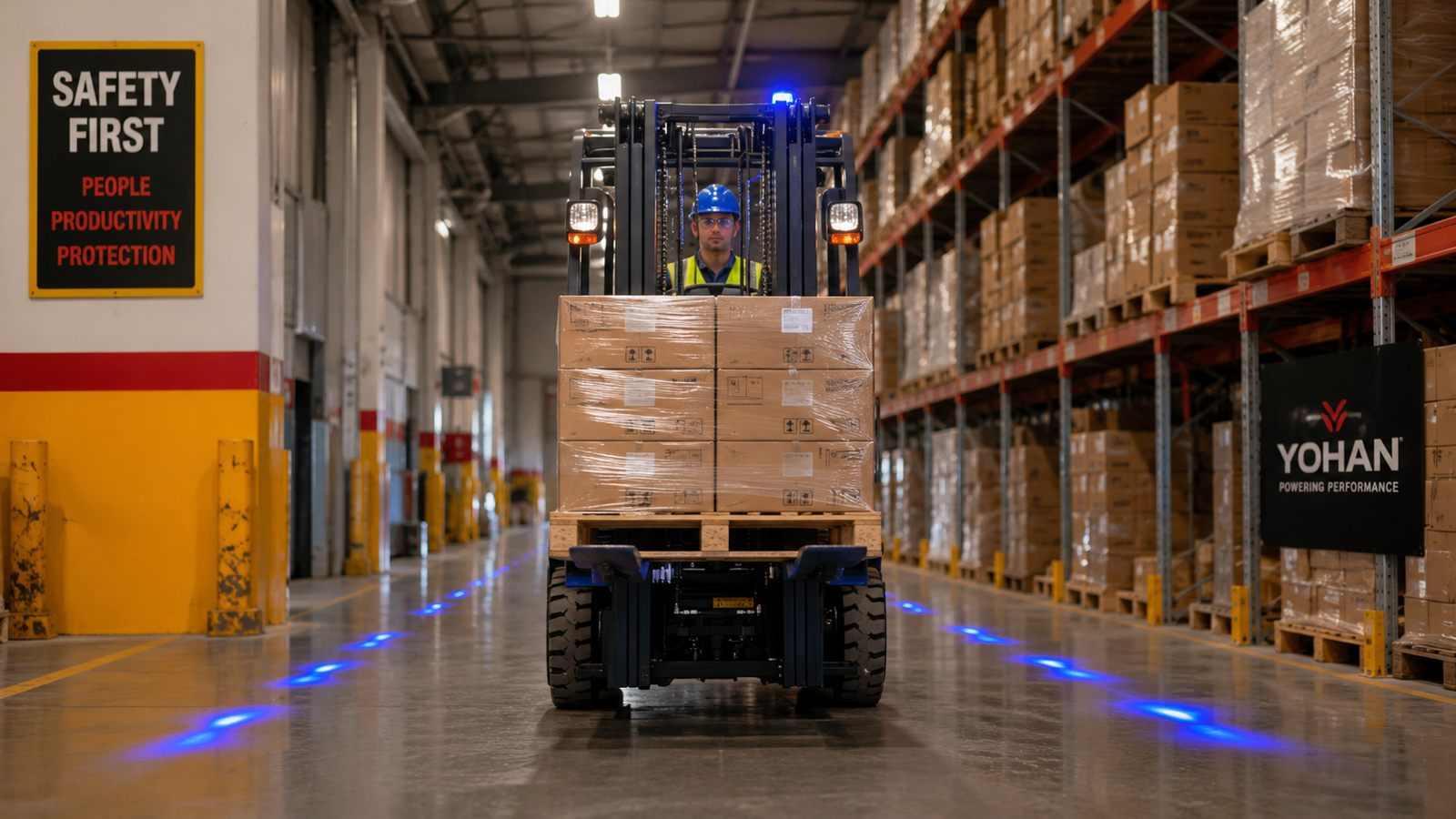
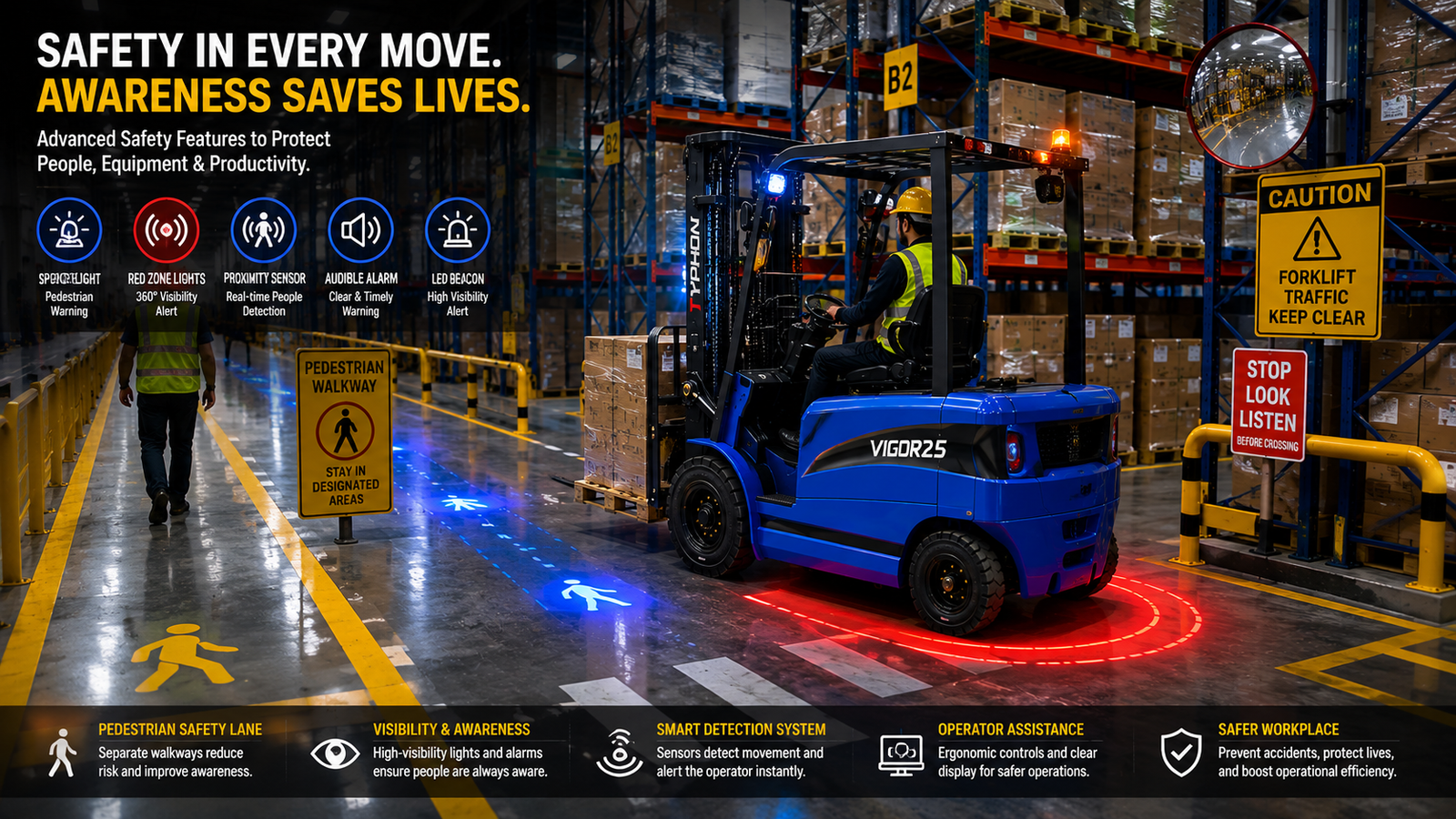
Pedestrian warning systems help bridge that communication gap. Blue spotlights, red zone lights, backup alarms, directional travel alarms, strobes, and proximity warning systems all make forklift movement more visible and predictable. Blue lights project a warning onto the floor ahead of the forklift, giving pedestrians advance notice before the machine reaches an intersection. Red zone lights create a visible boundary around the forklift, discouraging workers from walking too close to the machine during operation. More advanced proximity systems can detect pedestrians, tags, or obstacles and alert the operator before a collision occurs.
Telematics and diagnostics add another powerful layer of safety control. These systems allow managers to track impacts, monitor speed events, review fault codes, manage operator access, and schedule maintenance before failures interrupt production. If a forklift records repeated impacts in the same aisle or with the same operator, management can respond with targeted training, traffic redesign, or equipment inspection. Diagnostics also help identify problems with brakes, batteries, controllers, or hydraulic systems before they become dangerous failures. This turns safety from a reactive process into a data-driven management strategy.
Ergonomic safety-focused design completes the picture by protecting the operator throughout the shift. A comfortable, well-positioned seat, intuitive controls, low-effort steering, clear displays, easy entry and exit points, and reduced vibration all contribute to safer performance. Fatigued operators are more likely to misjudge turns, overlook pedestrians, or mishandle loads. When a forklift is designed around the operator’s comfort and control, it supports sharper attention, smoother operation, and fewer mistakes. Together, pedestrian alerts, telematics, diagnostics, and ergonomic design create a safer, more accountable warehouse environment while supporting uptime and long-term fleet value.
Conclusion
The top safety features every electric forklift should have are not simply technical upgrades. They are essential tools for protecting people, inventory, equipment, and operational continuity. Operator presence systems prevent uncontrolled movement. Speed control improves traffic safety. Load stability technology protects against tip-overs and falling pallets. Visibility enhancements sharpen awareness. Advanced braking systems deliver controlled stopping power. Pedestrian warnings, telematics, diagnostics, and ergonomic design help create a safer and more productive warehouse from every angle.
For warehouse managers, logistics leaders, operations teams, and equipment buyers, the right electric forklift should deliver more than clean power and efficient operation. It should actively reduce risk, support operator confidence, and protect the business from costly accidents and downtime. Before adding a machine to your fleet, evaluate its safety systems with the same seriousness as its lift capacity, battery performance, and price. A safer forklift is a more reliable forklift, and a more reliable forklift helps build a stronger, more efficient operation.