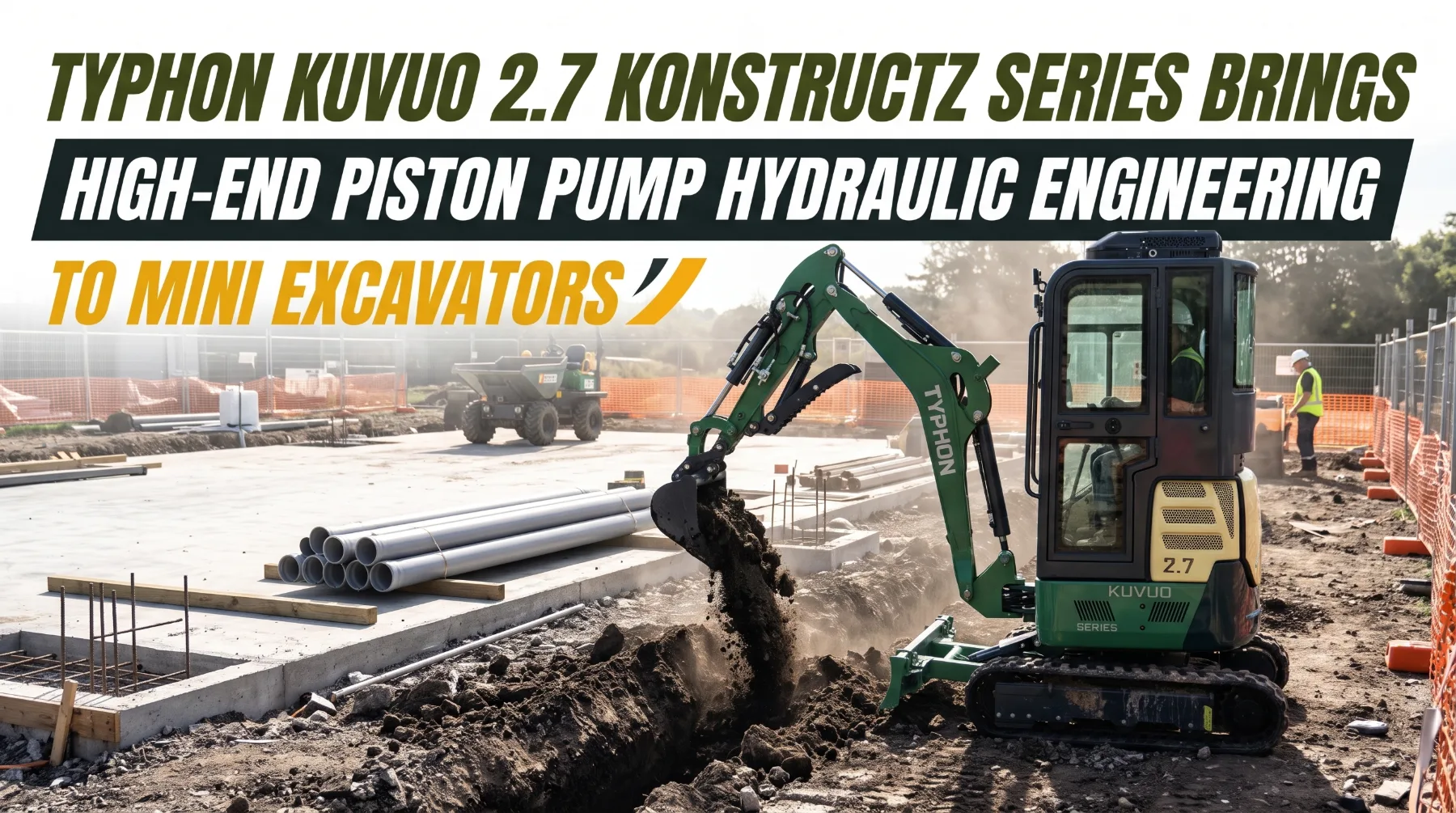
An operator's control over a mini excavator depends on the hydraulic system that turns each joystick command into motion. When the bucket trims a footing edge or the boom lifts a load of wet clay, the hydraulic system determines how quickly and accurately the machine responds. Two machines with similar engines can feel very different at the controls because of what happens between the engine and the cylinders.
Hydraulic architecture shapes that response. The pump sets how fluid is delivered. Valves, controls, engine output, and hydraulic circuits then decide how that flow reaches the boom, arm, bucket, swing, and attachments. The TYPHON KUVUO 2.7 KONSTRUCTZ Series combines a variable-displacement axial piston pump with full hydraulic pilot joystick controls. The result is a system designed for responsive excavation and compatible attachment work.
Knowing how this system works helps contractors evaluate it on more than a single number. This guide explains the piston pump, the meaning of the KUVUO 2.7's published hydraulic figures, and how the system handles combined movements. It also covers the attachment checks and maintenance habits that keep hydraulic performance consistent over the life of the machine.
How a Variable-Displacement Piston Pump Works
A hydraulic pump converts mechanical power from the engine into fluid flow. In a fixed-displacement design, the pump moves the same volume of fluid every revolution, whether the machine is breaking out compacted soil or sitting at idle between passes. That simplicity has a cost, because the pump can't adapt its delivery to what the operator needs at each moment.
A variable-displacement axial piston pump can change how much fluid it moves per revolution, according to its design and control system. For contractors considering why to choose TYPHON mini excavators for everyday jobsite work, this technology offers a useful example of how hydraulic engineering can support changing operating demands. Pistons sit inside a rotating cylinder block, and an angled swashplate sets their stroke length. When the control system changes the swashplate angle, displacement changes with it, allowing hydraulic delivery to follow operating demand rather than staying locked at one volume.
The exact behavior depends on the pump and the machine's hydraulic control arrangement. Two excavators with piston pumps can still respond differently because their control strategies differ. For that reason, published specifications are best treated as a starting point, and a hands-on demonstration remains the most reliable way to judge how the system responds to your work.
Key takeaway: The KUVUO 2.7's variable-displacement axial piston pump adjusts fluid delivery to match operating demand, while overall response depends on the machine's complete hydraulic control arrangement.
Why Pump Displacement Matters
Pump displacement is the volume of fluid the pump moves during one revolution. Engineers and buyers use it as a basic measure of a pump's size and potential output. The KUVUO 2.7 product listing specifies a pump displacement of 28 ml/rev.
Displacement and flow are related, but they are not the same thing. Flow equals displacement multiplied by pump speed, and in a variable design the control system can reduce displacement when demand drops. Actual hydraulic flow therefore depends on engine speed, control behavior, and system conditions at any given moment.
Treat displacement as one piece of the hydraulic picture. Compare it alongside total flow, system pressure, and the specifications for individual circuits. A machine's complete hydraulic capability only becomes clear when you view these figures together rather than relying on displacement alone.
Key takeaway: The KUVUO 2.7's 28 ml/rev displacement defines the pump's volume per revolution, but real flow also depends on pump speed, control behavior, and operating conditions.
Attachment Compatibility and Hydraulic Care
Hydraulic attachments can turn a mini excavator into an auger rig, a breaker, or a precise material handler. Every attachment, however, places specific demands on the machine's hydraulic system. Confirm these five points before connecting any tool.
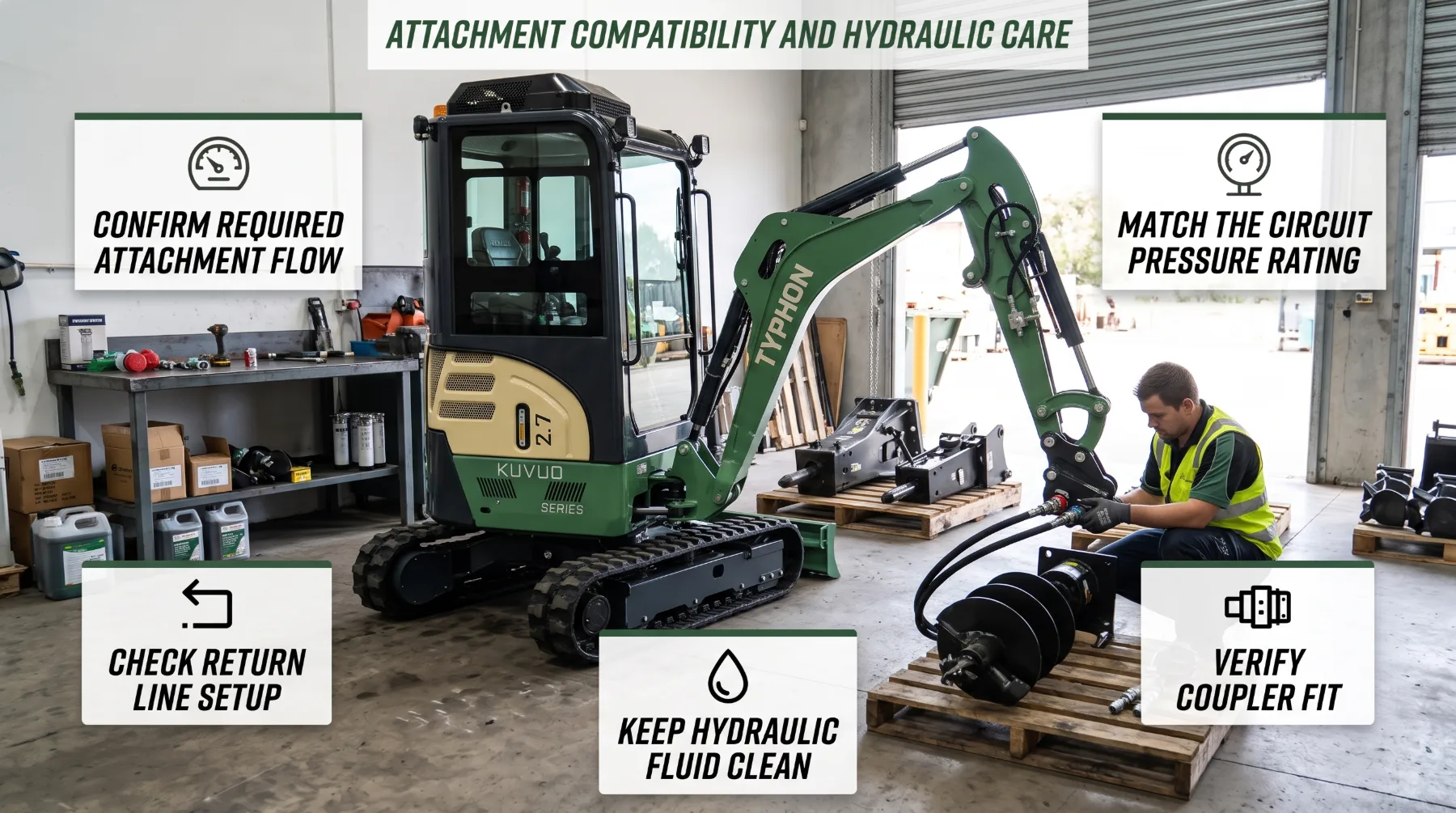
Flow Requirement: Make sure the attachment's required flow falls within the auxiliary circuit's output.
Pressure Rating: Confirm the attachment is rated for the circuit's operating pressure.
Return Line Setup: Check whether the tool requires a case drain or a dedicated return line.
Coupler Fit: Verify that couplers and connection types match the machine's hydraulic setup.
Fluid Cleanliness: Use the specified fluid, wipe couplers before connecting, and follow filter service intervals.
Key takeaway: Matching flow, pressure, return lines, and couplers while keeping fluid clean protects both the attachment and the KUVUO 2.7's hydraulic components from avoidable wear and damage.
Pilot Controls and Operator Input
Full hydraulic pilot joystick controls let the operator command machine functions through low-pressure pilot signals. A joystick movement shifts a control valve, and that valve directs main hydraulic flow to the selected function. Because the operator moves a pilot signal rather than the main flow directly, input effort stays low and response stays proportional.
Proportional control pays off in precision work. Trimming soil around a foundation, opening a drainage route along a property line, or setting a bucket beside an existing structure all call for small, deliberate movements. Pilot controls let operators feather inputs so the boom and bucket move smoothly instead of lurching into position.
Precision also depends on the operator and the machine's condition. Experience, hydraulic fluid quality, component wear, and the nature of the task all influence the outcome. Clean fluid and a well-maintained system preserve the smooth response that pilot controls are designed to deliver.
Key takeaway: Pilot joystick controls give operators smooth, proportional command of the KUVUO 2.7, and that precision is protected by operator skill and good hydraulic maintenance.
Hydraulic Flow and System Pressure
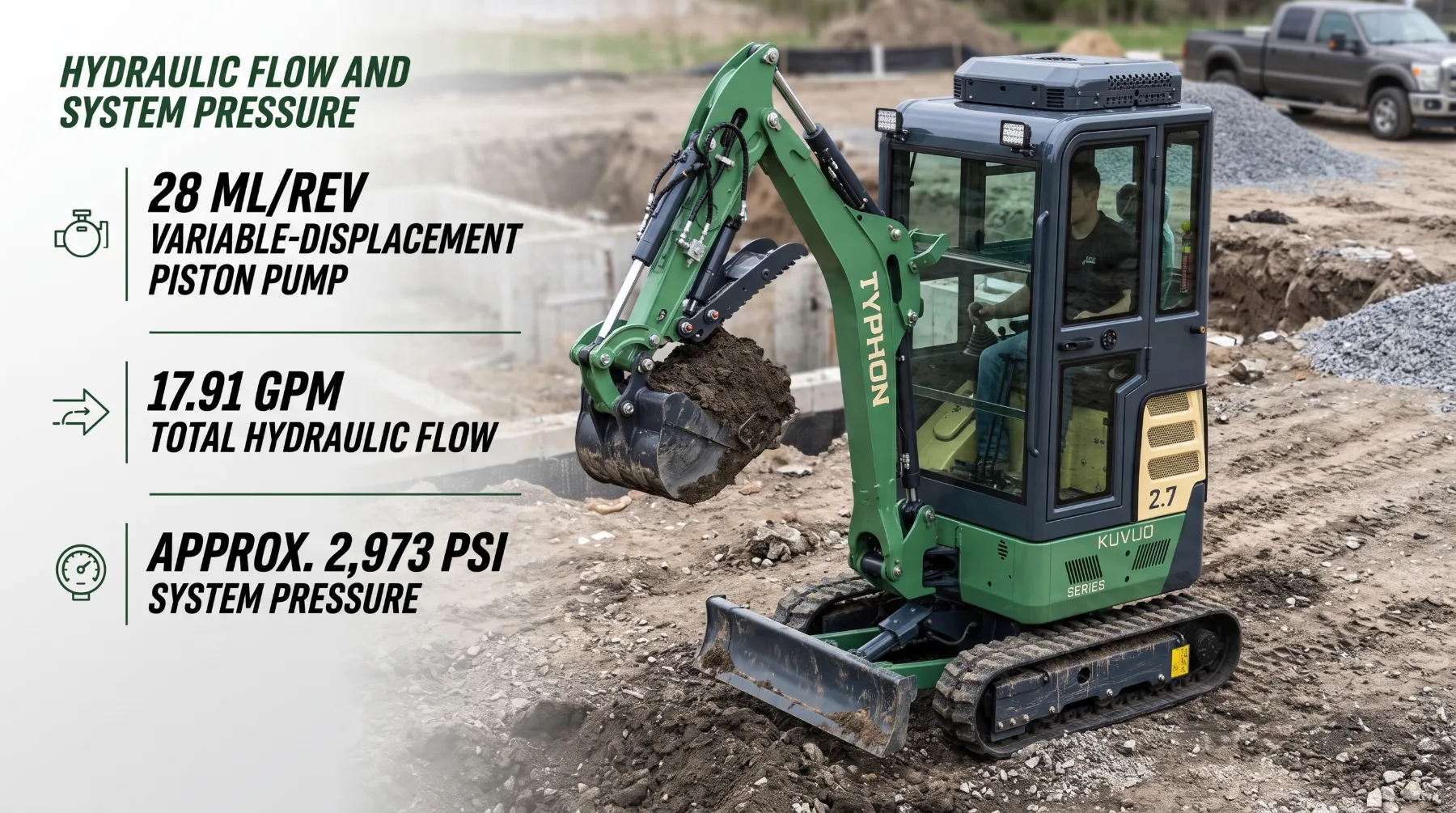
Flow and pressure perform separate jobs. Flow mainly governs how fast cylinders extend and hydraulic motors turn. Pressure contributes to the force those components can produce when they meet resistance, such as a bucket cutting into dense ground.
The KUVUO 2.7 listing specifies total hydraulic flow of 17.91 GPM and system pressure of approximately 2,973 PSI. These figures work as a pair. Strong pressure with limited flow can make movements feel slow, while plenty of flow without adequate pressure can leave the machine short on force under load. Balanced figures support work that is both quick and capable.
Total system flow is also different from the flow available at an individual circuit. Auxiliary circuits that power attachments may carry their own flow and pressure limits. Review the manufacturer's guidance for each circuit before planning attachment work around the headline system figure.
Key takeaway: Read the KUVUO 2.7's 17.91 GPM total flow and approximately 2,973 PSI system pressure together, and confirm circuit-level figures before matching attachments.
Supporting Multiple Excavation Movements
Productive excavation rarely relies on one function at a time. A skilled operator blends boom, arm, bucket, and swing movements into one fluid cycle, curling the bucket while raising the boom and starting the swing toward the spoil pile. That overlap keeps cycle times short across a long day.
When several functions operate together, they draw from the same hydraulic supply. The system distributes available flow according to its design and the functions in use. During combined movements, an individual function may receive less flow than it would when operated alone.
Pump displacement doesn't by itself guarantee simultaneous full-speed movement on every function. Compare published specifications with what you observe during a demonstration. Watching the machine complete full dig cycles on representative ground shows how its hydraulic system handles real combined work.
Key takeaway: Combined movements share available hydraulic flow, so evaluate the KUVUO 2.7's multi-function response during a demonstration instead of assuming it from pump size.
Conclusion
The TYPHON KUVUO 2.7 KONSTRUCTZ Series delivers high-end hydraulic engineering in a compact package designed to support precise excavation, efficient material handling, and dependable performance across a range of jobsite conditions. Its key hydraulic components work together to provide responsive operation, including a variable-displacement axial piston pump that adjusts delivery to operating demand, a 28 ml/rev displacement that defines pump volume per revolution, 17.91 GPM total flow, and approximately 2,973 PSI system pressure. Full pilot joystick controls support smooth, proportional movements, helping operators manage digging, bucket positioning, and swing functions when working around foundations, utilities, landscaping features, and other obstacles. Overall performance also depends on hydraulic circuit design, cylinder sizing, ground conditions, material density, attachment selection, and the operator's ability to coordinate multiple functions during each work cycle. To maintain reliable operation, inspect hydraulic hoses, fittings, cylinders, seals, and couplers regularly, check fluid levels according to the manufacturer's instructions, use the specified hydraulic fluid and filters, and follow recommended service intervals. Keeping connection points clean helps prevent contamination, while paying attention to unusual noises, excessive heat, leaks, or inconsistent control responses can help identify potential problems before they become more serious. Before using the machine, review its published specifications and confirm that each attachment meets the required hydraulic flow, pressure, return-line, and coupler requirements. Testing normal digging movements, combined boom and arm functions, bucket positioning, and swing operation during a demonstration can also provide a clearer understanding of the machine's control response and practical capabilities. By evaluating hydraulic specifications alongside maintenance requirements, attachment compatibility, operating conditions, and project demands, buyers can make a more informed decision about whether the TYPHON KUVUO 2.7 KONSTRUCTZ Series is the right compact excavator for their construction, landscaping, trenching, and general excavation needs.
Frequently Asked Questions
What is the advantage of a variable-displacement piston pump?
A variable-displacement piston pump can change the volume of fluid it moves per revolution to match operating demand. This allows hydraulic delivery to follow the workload more closely than a fixed-displacement design. Actual response depends on the pump's design and the machine's control system.
Does pump displacement equal hydraulic flow?
No. Displacement is the volume moved per revolution, while flow also depends on pump speed and how the system operates. That is why the KUVUO 2.7 publishes both a 28 ml/rev displacement and a 17.91 GPM total flow figure.
Why do flow and pressure both matter?
Flow mainly affects how fast cylinders and motors move. Pressure contributes to the force they can produce under load. A balanced combination supports hydraulic work that is responsive and capable.
Can every hydraulic attachment be used on the KUVUO 2.7?
No. Confirm each attachment's flow, pressure, connection, and return requirements against the machine's specifications. An incompatible attachment can reduce performance and damage hydraulic components.