On-Board Forklift Charging vs. Battery Rooms
Your material handling efficiency relies directly on how you power your equipment. If your electric forklifts stop moving, your entire supply chain grinds to a halt. Facility managers face a critical decision when designing their power infrastructure. You must choose between centralized traditional battery rooms and decentralized on-board charging systems.
This decision impacts every aspect of your operation. It dictates how much usable space you have for inventory. It determines your daily labor costs and shapes your workplace safety protocols. Making the wrong choice leads to hidden expenses and severe productivity bottlenecks.
We deliver reliable, trustworthy guidance to help you optimize your facility. This guide breaks down the core differences between on-board forklift charging and dedicated battery rooms. You will discover how space utilization, operational efficiency, safety standards, and long-term costs vary between these two approaches. By understanding these factors, you can confidently build a power strategy that maximizes your warehouse productivity.

Understanding Traditional Battery Rooms
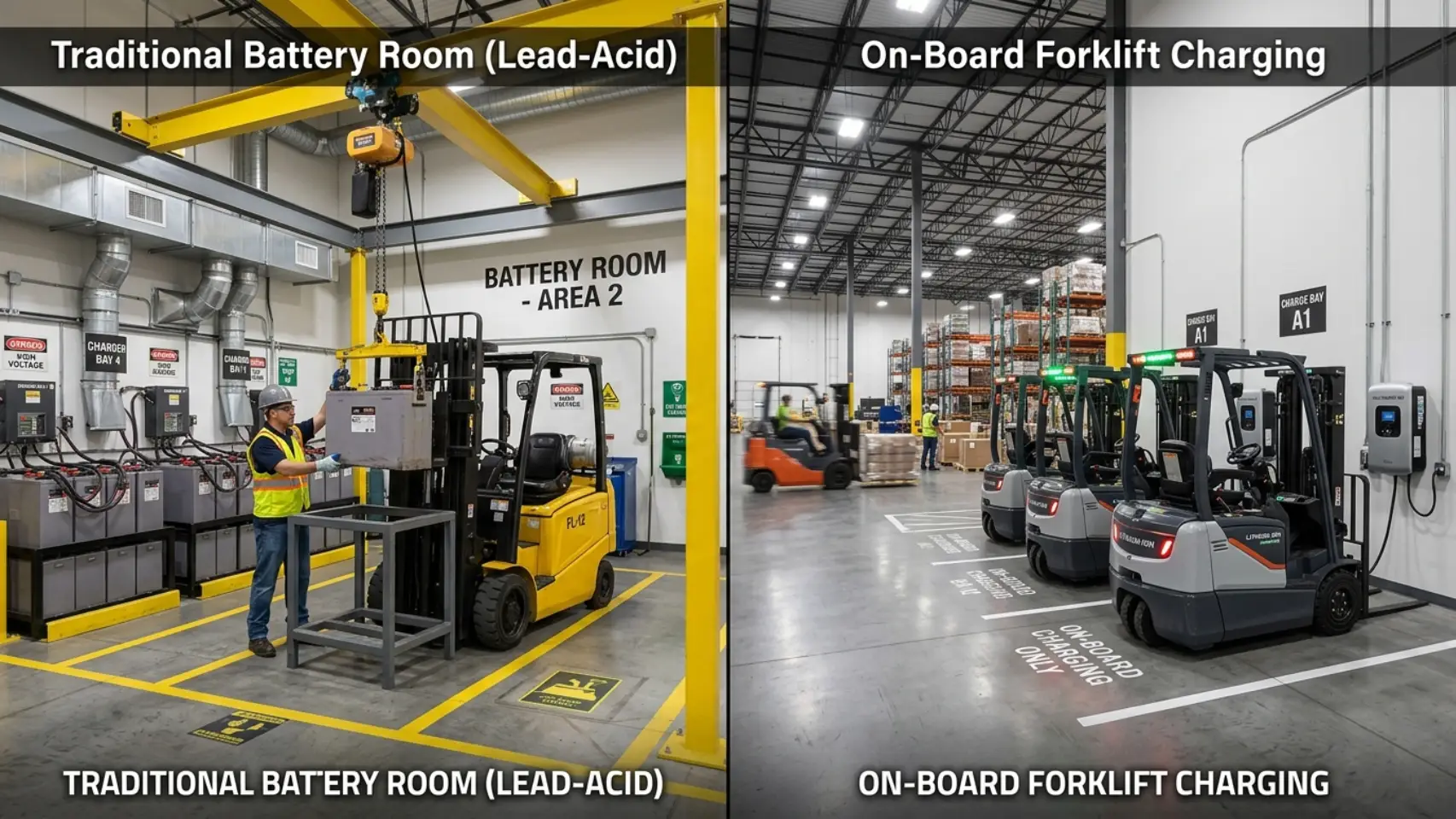
Traditional battery rooms are a cornerstone of electric forklift operations, especially for fleets powered by lead-acid batteries. These dedicated rooms are specifically engineered to handle the physical, electrical, and environmental demands of large-scale battery management. The setup typically includes heavy-duty racks to store multiple batteries, robust extraction equipment—such as battery lifting beams or roller beds—for efficient battery swaps, and industrial-grade chargers capable of supporting high-frequency charging cycles. Specialized safety infrastructure is also mandatory, including acid-resistant floors, eyewash stations, spill containment kits, and powerful ventilation systems to manage hazardous fumes released during charging and equalization.
Maintaining a battery room demands diligent oversight and strict adherence to best practices. Lead-acid batteries require frequent watering to maintain proper electrolyte levels and regular cleaning to prevent the buildup of acid residue and corrosion on terminals. Routine inspections are essential to identify damaged cables, faulty connectors, and leaking cells, all of which must be addressed immediately to safeguard both equipment reliability and operator safety. Safety compliance is non-negotiable; all personnel working in battery rooms must be trained in chemical handling, personal protective equipment usage, and emergency spill response.
Despite their widespread use, traditional battery rooms present considerable operational challenges. The battery swapping process is labor-intensive and disrupts workflow, as forklifts must be driven out of rotation, lined up for extraction, and individually serviced before returning to the floor. Swapping often requires two to three batteries per forklift to maintain continuous operation across multiple shifts, significantly escalating storage and equipment costs. Additionally, centralized charging and maintenance activities can result in bottlenecks during shift changes, contributing to unnecessary downtime.
Aging battery room infrastructure can further strain operational budgets through increased maintenance needs and energy inefficiencies. Over time, ventilation systems and charging equipment may require costly upgrades to remain compliant with safety codes and to meet the growing demands of a modern warehouse environment.
By understanding these practical realities, facility managers are better equipped to assess whether the traditional battery room model aligns with their long-term operational and financial objectives.
For decades, the battery room served as the standard power hub for electric material handling fleets. These dedicated spaces house lead-acid batteries, extraction equipment, and heavy-duty chargers. While this traditional approach remains common, you must understand exactly how it functions to evaluate its true cost.
How Centralized Charging Functions
A traditional battery room centralizes all power management in one specific location. When a forklift battery runs low, the operator drives the vehicle to this dedicated room. They use specialized hoists or extraction machines to remove the depleted battery from the forklift.
Next, the operator inserts a fully charged spare battery into the vehicle. They connect the depleted battery to a charger and log the maintenance details. The operator then returns to the floor to resume their shift. This process requires a strict rotation schedule to ensure spare batteries have adequate time to charge and cool down before their next use.
The Advantages of Battery Swapping
Traditional battery rooms offer specific benefits for intensive, multi-shift operations using lead-acid technology. Because you swap a dead battery for a fresh one, the forklift itself never sits idle while connected to a charger.
This system allows you to run a single forklift 24 hours a day, provided you own three batteries for that specific machine. Furthermore, centralizing your power equipment simplifies safety compliance. You concentrate all your acid spill kits, eyewash stations, and heavy ventilation systems in one easily monitored room. Maintenance teams know exactly where to go to water batteries and perform equalization charges.
The Hidden Costs of Battery Extraction
Despite these benefits, battery rooms introduce significant operational friction. The extraction process is labor-intensive and consumes valuable time. A standard battery swap takes an operator between twenty and thirty minutes to complete.
If you run a fleet of ten forklifts across two shifts, you lose dozens of labor hours every single week simply swapping batteries. Additionally, lead-acid batteries require constant maintenance. Your technicians must spend hours each week checking water levels and cleaning corrosive acid spills. These continuous labor demands quietly erode your profit margins.
Exploring On-Board Forklift Charging
On-board forklift charging represents a significant evolution in warehouse power management, driven largely by the adoption of lithium-ion battery technology. This system eliminates the need for battery extraction entirely—operators simply plug their forklift into a charger without removing the battery from the equipment.
Enhanced Benefits for Modern Warehouses
The advantages of on-board charging extend well beyond convenience. By supporting opportunity charging, operators can top up batteries during scheduled breaks or shift changes, ensuring forklifts remain operational without extended downtime. This contributes directly to higher productivity, as equipment spends more time on the floor fulfilling critical tasks rather than waiting for battery swaps.
On-board charging drastically reduces labor required for power management. Operators no longer spend time transporting forklifts to a centralized location, using hoists, or managing complex rotation schedules. Instead, decentralized chargers distributed throughout the facility increase flexibility, supporting operators in their actual work zones and streamlining workflow. This flexibility also enables better task scheduling and adapts quickly to changing warehouse demands, improving throughput and reducing labor costs.
From a maintenance perspective, on-board charging—especially with lithium-ion batteries—virtually eliminates the need for watering, equalization, and heavy routine service. Lithium-ion units are sealed, safe, and require minimal intervention, thereby reducing the risk of hazardous spills and exposure to toxic substances. This minimizes compliance concerns, simplifies operator training, and further enhances workplace safety.
Energy efficiency is another critical benefit. On-board systems paired with modern lithium-ion batteries convert grid energy into usable power with minimal loss. They also avoid the heat and gas emissions associated with charging and maintaining traditional lead-acid batteries, supporting a healthier working environment and helping facilities meet sustainability benchmarks.
Implementation Challenges and Considerations
Transitioning to on-board forklift charging is an investment that requires planning and capital allocation. Upfront costs include not only the lithium-ion batteries and onboard charging units but also potential upgrades to the facility’s electrical infrastructure. Facility managers should assess current electrical panel capacity and may need to install new circuits or upgrade safety features to support high-frequency charging at multiple locations.
Reliability during peak demand is another consideration. The decentralized nature of on-board charging means charging points must be easily accessible and strategically placed near key operational areas, such as loading docks, staging zones, and break rooms. Careful mapping and load management are vital to prevent any single point from becoming a bottleneck.
It’s essential to develop comprehensive safety protocols for on-board charging stations. Although much safer than traditional battery rooms, the use of multiple distributed electrical chargers requires new training for operators. Clear signage, physical barriers, and cable management systems help prevent accidents and equipment damage. Regular audits and equipment checks ensure all stations remain compliant and operational.
Best Practices for Implementation
A successful transition to on-board forklift charging starts with a facility-wide assessment of workflow patterns, current battery management costs, and warehouse layout. In partnership with a trusted equipment supplier or power consultant, managers should model potential efficiency gains and plan the placement of charging infrastructure based on real operator traffic and operational needs.
Pilot programs are a practical way to observe real-world impacts before making a full investment. Start by outfitting a portion of the fleet with on-board charging and measure key metrics such as productivity improvements, maintenance savings, and downtime reductions. Solicit operator feedback to identify unforeseen challenges and refine training programs.
Lastly, ongoing support and education are crucial for sustained success. Schedule regular refresher sessions for operators on safe charging procedures and routine inspection protocols. Monitor system performance and adjust your infrastructure as operational needs and fleet size evolve.
By taking a strategic, customer-focused approach, you can ensure that the move to on-board charging delivers lasting value—improving reliability, maximizing productivity, and empowering your warehouse team to exceed customer expectations with confidence.
Advances in battery technology, specifically the rise of lithium-ion power, have transformed how facilities manage equipment charging. On-board charging eliminates the need to remove the battery from the vehicle entirely.
The Mechanics of Opportunity Charging
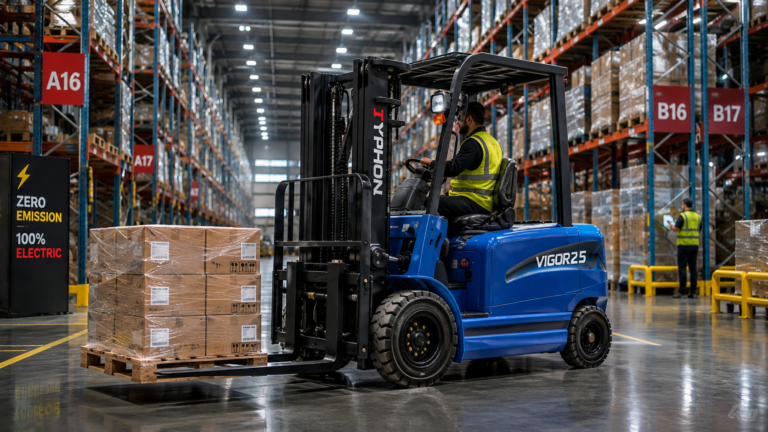
On-board charging systems pair advanced batteries with compact, high-frequency chargers distributed throughout your facility. Operators do not remove the power cell. Instead, they drive the forklift directly to a charging station and plug the vehicle into the power grid.
This approach utilizes a concept called opportunity charging. Operators plug in their forklifts during scheduled breaks, lunches, or shift changes. Because modern lithium-ion batteries accept power rapidly without generating dangerous heat, brief charging sessions keep the battery sufficiently topped off throughout the entire workday.
Decentralizing Your Power Infrastructure
Moving away from a central battery room changes your entire warehouse workflow. You can install sleek, wall-mounted chargers near break rooms, loading docks, or specific work zones.
This decentralized approach drastically reduces travel time. Operators no longer waste ten minutes driving across a massive facility just to reach a central battery room. They park near their work area, plug in the machine, and take their scheduled break. When their break ends, the machine is ready to immediately resume moving freight.
Potential Setup Challenges to Consider
While on-board charging delivers immense efficiency, it requires careful initial planning. Upgrading to lithium-ion batteries and advanced chargers demands a higher upfront capital investment than buying standard lead-acid units.
Furthermore, you must evaluate your facility’s electrical infrastructure. Distributing high-frequency chargers throughout the building might require installing new electrical panels or running additional heavy-duty wiring. You need a trusted power partner to audit your current electrical capacity before committing to a decentralized charging network.
Evaluating Space Utilization
Effective use of warehouse space is a decisive factor in operational efficiency and long-term profitability. The choice between traditional battery rooms and on-board charging systems directly shapes how your facility can be organized and optimized for maximum productivity.
Traditional battery rooms command a significant footprint within the warehouse. These centralized zones must accommodate not only heavy battery extraction equipment, chargers, and spare battery racks, but also comply with strict safety requirements—like adequate ventilation systems, spill containment, and hazardous material storage. As a result, vital square footage is diverted away from revenue-generating activities. High-volume battery traffic during shifts can lead to congestion near battery rooms, forcing designers to widen aisles or create staging areas, further reducing available storage or operational space.
This centralized layout imposes workflow limitations. Operators are often required to travel considerable distances from their work zones to access the battery room, taking forklifts off productive tasks. Multiple machines may be queued for swaps, intensifying downtime and introducing bottlenecks during peak operational hours. In addition, battery room locations often dictate the flow of goods and personnel, sometimes creating “dead zones” within the facility that cannot be repurposed for storage or other critical functions.
On-board charging, by contrast, empowers facility managers to reimagine their warehouse layouts with greater flexibility. Compact, distributed charging stations can be strategically positioned near high-traffic operational areas, such as shipping docks, picking zones, or break rooms. This strategic placement means operators can recharge equipment during natural workflow breaks with minimal disruption and absolutely no need for extraction equipment or battery storage racks, thus reclaiming valuable space for inventory and other operational priorities.
Decentralized on-board charging fosters more efficient travel paths for both machinery and personnel. With the elimination of bottlenecks and traffic jams historically associated with battery swap rooms, you can streamline aisle configurations, reduce unnecessary detours, and boost the overall safety and flow of your operation. For expanding operations or facilities handling mixed product lines, the adaptable nature of on-board charging infrastructure allows painless scaling and reconfiguration as business demands evolve.
Ultimately, by embracing on-board charging, facilities have the opportunity to convert previously dedicated battery room square footage into high-density storage, expanded product staging, or new revenue-stream work cells. This transition is not just about saving space—it’s about future-proofing your warehouse layout, maximizing throughput, and providing your team with the tools to deliver consistent, customer-focused results.
Warehouse real estate is incredibly expensive. How you use your square footage directly impacts your storage capacity and overall revenue potential.
Reclaiming Valuable Real Estate
A traditional battery room requires massive amounts of space. You need room for the extraction equipment, storage racks for spare batteries, charging pedestals, and specialized ventilation systems. In a large facility, a battery room easily consumes hundreds or even thousands of square feet.
On-board charging systems completely eliminate the need for this dedicated room. You do not need spare batteries, extraction hoists, or massive storage racks. Facility managers who switch to on-board charging often demolish their old battery rooms. They convert that reclaimed space into highly profitable inventory storage or additional packing lines.
Streamlining Facility Traffic
Centralized battery rooms create intense traffic bottlenecks. During shift changes, multiple operators often rush to the battery room simultaneously to swap their power cells. This congestion creates delays and increases the risk of collisions.
Decentralized on-board chargers spread your fleet out across the facility during downtime. You eliminate the end-of-shift traffic jams at the battery room doors. Operators move predictably and safely within their designated zones, improving the overall flow of your warehouse traffic.
Prioritizing Workplace Safety
Workplace safety is the cornerstone of any successful warehouse operation, and establishing rigorous, well-documented protocols is non-negotiable when it comes to charging systems. The choice between battery rooms and on-board charging systems directly affects the kinds of risks your team faces each day—and determines the strategies you must employ to manage those risks effectively.
Comprehensive Safety Protocols for Battery Rooms
Traditional battery rooms demand a systematic approach to safety, grounded in both regulatory compliance and proactive risk mitigation. Operators and maintenance staff must be thoroughly trained in chemical hazard protocols, including the proper use of personal protective equipment (PPE) such as acid-resistant gloves, goggles, and face shields. All battery room personnel should participate in regular safety drills covering spill containment procedures, eyewash station use, and emergency shutdown processes.
Housekeeping is vital. Acid spills must be neutralized and cleaned immediately, and any accumulation of residue on floors or terminals should be addressed daily to prevent slips, corrosion, or accidental contact burns. Strict ventilation requirements must be met and monitored with ventilation alarms or air quality sensors, as harmful hydrogen gas is released during certain charging cycles. High-visibility signage and restricted access help protect other warehouse staff from accidental exposure, ensuring only credentialed, trained individuals enter the battery room.
Crucially, battery extraction and insertion involve the use of overhead hoists, roller beds, or transfer carts. Only certified personnel should operate this equipment, following clear, step-by-step checklists to prevent pinch points, dropped loads, or uncontrolled battery movement. Routine equipment inspections and maintenance logs are essential to mitigate mechanical failure risks and maintain OSHA compliance.
Modern Risk Management for On-Board Charging
On-board charging—especially with sealed lithium-ion batteries—virtually eliminates the chemical and mechanical hazards inherent in battery rooms. However, robust electrical safety protocols must still be implemented throughout the charging infrastructure.
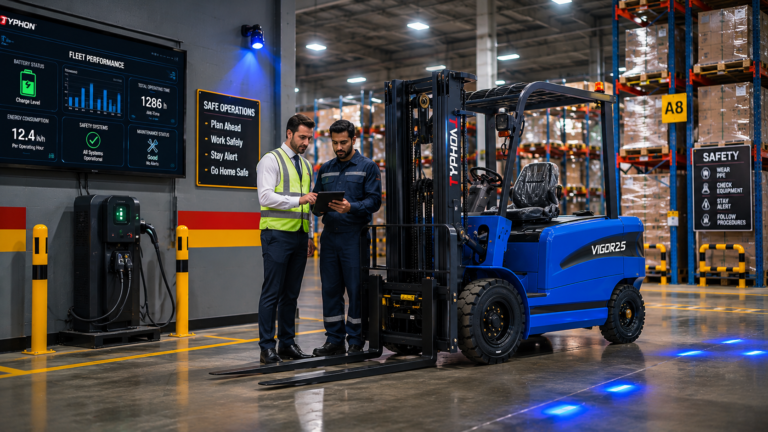
Charging stations should be physically protected with bollards or guardrails to prevent forklifts from accidentally impacting the equipment. Each station must be equipped with clear signage stating voltage levels, proper plug-in procedures, and emergency disconnect locations. Operators need standardized training in cable management to prevent tripping hazards and equipment damage. The use of retractable or overhead cable systems is highly recommended to keep walkways clear and charging areas organized.
Regular audits ensure all charging points function as intended and remain compliant with electrical codes and operational standards. Facilities should implement immediate incident reporting protocols to address any damaged outlets, frayed cables, or malfunctioning chargers before they escalate to safety issues.
In addition to electrical safety, ongoing operator education is crucial. Even with reduced physical risk, all team members should be aware of emergency response plans for electrical fires or charger malfunctions. It is wise to conduct periodic refresher training, incorporating simulated drills that emphasize quick, safe reactions under pressure.
Building a Culture of Safety and Accountability
Regardless of charging method, safety leadership starts at the management level. Supervisors should set clear expectations, conduct routine walkthroughs, and solicit feedback on safety improvements from front-line staff. Providing accessible documentation, visible checklists, and maintaining open channels for reporting hazards all contribute to a robust and proactive safety culture.
By instituting comprehensive protocols and fostering accountability at every level, both traditional battery rooms and on-board charging methods can operate safely and efficiently, ensuring peace of mind for management and optimal protection for every member of your warehouse team.
We believe that protecting your personnel is the most critical responsibility of any facility manager. Your charging infrastructure heavily influences your daily safety risks.
Eliminating Acid and Hoist Hazards
Traditional lead-acid batteries weigh thousands of pounds. Moving them with overhead hoists creates a constant risk of severe crush injuries. Furthermore, these batteries contain toxic sulfuric acid. Routine maintenance exposes your workers to chemical burns and hazardous off-gassing.
On-board charging, particularly with sealed lithium-ion batteries, removes these dangers entirely. Operators never handle the battery physically. They never connect extraction hoists, and they never interact with corrosive liquids. By eliminating the battery swap process, you immediately remove a major source of workplace injuries and costly worker compensation claims.
Maintaining Safe Electrical Connections
While on-board charging removes chemical and crushing hazards, it introduces new electrical considerations. You must ensure your charging stations feature prominent physical barriers to prevent forklifts from backing into the electrical panels.
You must also train operators to handle charging cables correctly. Cables left lying on the floor create tripping hazards and can be crushed by passing machinery. We recommend installing retractable cable management systems to keep your charging stations safe, organized, and compliant with industrial safety standards.
Calculating Long-Term Costs and Productivity
When considering how to power your forklift fleet, analyzing long-term costs and productivity metrics is critical for sound financial planning and operational efficiency. Both traditional battery rooms and on-board charging come with distinct cost profiles and impact workflow in different ways.
Detailed Cost Analysis
Traditional battery rooms may seem cost-effective at first glance due to the lower sticker price of lead-acid batteries. However, this initial advantage is quickly offset by hidden expenses over time. Each forklift typically requires multiple lead-acid batteries to support multi-shift operations, increasing capital outlay. The battery room itself incurs ongoing costs for HVAC, ventilation upgrades, acid mitigation equipment, and compliance audits. Regular maintenance—watering, cleaning, equalization, and routine replacements—demands substantial labor, often consuming several hours per week for each unit. Additionally, the need for operators to perform time-consuming swaps inflates both labor costs and non-productive time.
Unexpected repairs and environmental fees must also be factored in. Lead-acid batteries have a relatively short operational life; premature battery failure or sulfation can necessitate early replacements, and the costs for recycling and hazardous material disposal add further financial burdens. All these ongoing requirements create a total cost of ownership that frequently exceeds initial estimations.
By contrast, on-board charging with lithium-ion batteries offers savings primarily through efficiency and reduction of ancillary costs. You typically purchase a single battery per forklift rather than two or three. The infrastructure for distributed chargers is less invasive and cheaper to maintain over time, especially after the initial installation. Minimal routine maintenance eliminates laborious daily tasks, as lithium-ion batteries do not require watering, cleaning, or equalization. Their longer service life—often double or triple that of lead-acid—reduces the frequency and cost of battery replacement cycles.
Evaluating Productivity Metrics
The impact on productivity is just as important as direct costs. In traditional battery room setups, every battery swap represents lost operational time. For example, if each swap takes 20–30 minutes and each forklift requires two swaps per day, a 10-forklift fleet can lose over 80 labor hours per week solely to swapping activities. This not only removes operators from value-add tasks but also contributes to workflow disruptions, especially during high-volume periods or shift changes.
Furthermore, battery room congestion can lead to additional idle time, queueing delays, and potential safety risks due to crowded, high-traffic areas. These factors, though difficult to quantify, directly reduce throughput and may result in missed shipping windows.
On-board charging optimizes these productivity metrics by supporting opportunity charging during natural workflow breaks (lunches, shift changes). This model ensures forklifts remain available on the floor more consistently, maximizing run time and pallet movement per operator, per shift. Operators can quickly plug in their machines near their work zones, eliminating excessive travel and minimizing workflow interruptions. As a result, teams experience smoother shift transitions, predictable scheduling, and far less non-productive downtime.
By monitoring key KPIs—such as average pallets moved per hour, fleet uptime percentages, and operator labor utilization—facility managers who implement on-board charging typically report measurable increases in throughput, reduced turnaround time for loading/unloading, and faster response to fluctuating operational demands.
A thorough evaluation of both direct costs and productivity factors reveals that while traditional battery rooms may serve legacy needs, on-board charging delivers sustained financial savings, higher resource utilization, and long-term gains in facility efficiency. This holistic approach supports your commitment to operational excellence, reliability, and customer satisfaction.
To make the best decision for your business, you must look past the initial equipment price tag. You must evaluate the total cost of ownership over the lifespan of your forklift fleet.
The True Cost of Labor
Traditional battery rooms appear cheaper initially because lead-acid batteries cost less than advanced on-board systems. However, the continuous labor required to swap, water, and maintain those traditional batteries creates a massive financial drain.
On-board charging eliminates battery swapping downtime and requires zero daily maintenance. When you calculate the value of thirty minutes of lost time per operator, per shift, the math heavily favors on-board systems. The labor savings generated by opportunity charging typically offset the higher upfront equipment costs within the first two years of operation.
Maximizing Operator Output
Your operators are paid to move inventory, not to perform equipment maintenance. On-board charging keeps your staff focused entirely on their primary tasks.
By removing the friction of battery swaps, you increase the number of pallets each operator can move during their shift. This continuous, uninterrupted workflow boosts your facility’s total daily throughput. You meet shipping deadlines more consistently and provide a higher level of reliability to your customers.
Making the Right Choice for Your Facility
Choosing between a traditional battery room and on-board charging requires a thorough analysis of your specific operational needs. While battery rooms still serve a purpose in certain legacy applications, modern warehouses increasingly benefit from the flexibility and safety of on-board systems.
To determine the best path forward, assess your current fleet size and evaluate your daily shift structures. Calculate exactly how many labor hours you currently lose to battery swapping and maintenance. We strongly recommend consulting with a professional material handling expert to audit your facility. By taking a proactive approach to your power infrastructure, you can reclaim valuable space, protect your workforce, and build a highly profitable, efficient warehouse operation.