Stepping into the seat of an electric forklift for the first time can feel intimidating. The machine is powerful, the warehouse is busy, and the responsibility is real. Yet thousands of operators master these machines every year by learning a handful of core skills and practicing them with discipline. The path from nervous beginner to confident, productive operator is shorter than most people expect, provided you build the right habits from day one.
This guide is written for new operators, along with the warehouse managers, logistics leaders, operations teams, and equipment buyers who support them. Electric forklifts behave differently than internal combustion models. They deliver instant torque, run almost silently, and depend entirely on battery health for performance. Understanding these traits early prevents bad habits that slow you down or create safety risks. In this guide, you will learn the basic controls, how to run a proper pre-operation inspection, how to manage battery charging, how to travel and handle loads safely, and the common beginner mistakes worth avoiding. Master these fundamentals, and the machine becomes a reliable extension of your work rather than a source of stress.
Getting Comfortable With Basic Electric Forklift Controls
Every confident operator starts by understanding exactly what each control does before the machine ever moves. An electric forklift packs steering, acceleration, braking, lifting, tilting, and auxiliary functions into a compact operator compartment. For a beginner, the sheer number of levers, pedals, and switches can feel overwhelming, especially when a supervisor is waiting and the floor is active. Rushing this stage is where many new operators develop the jerky, uncertain habits that follow them for months.
The challenge is that electric machines respond instantly. Unlike an engine that needs a moment to build power, an electric drive delivers torque the second you press the accelerator. This means a heavy-footed beginner can lurch forward unexpectedly, startling nearby workers and shifting an unstable load. The same applies to the hydraulic controls. A small movement of the lift or tilt lever produces a faster, smoother response than many newcomers anticipate.
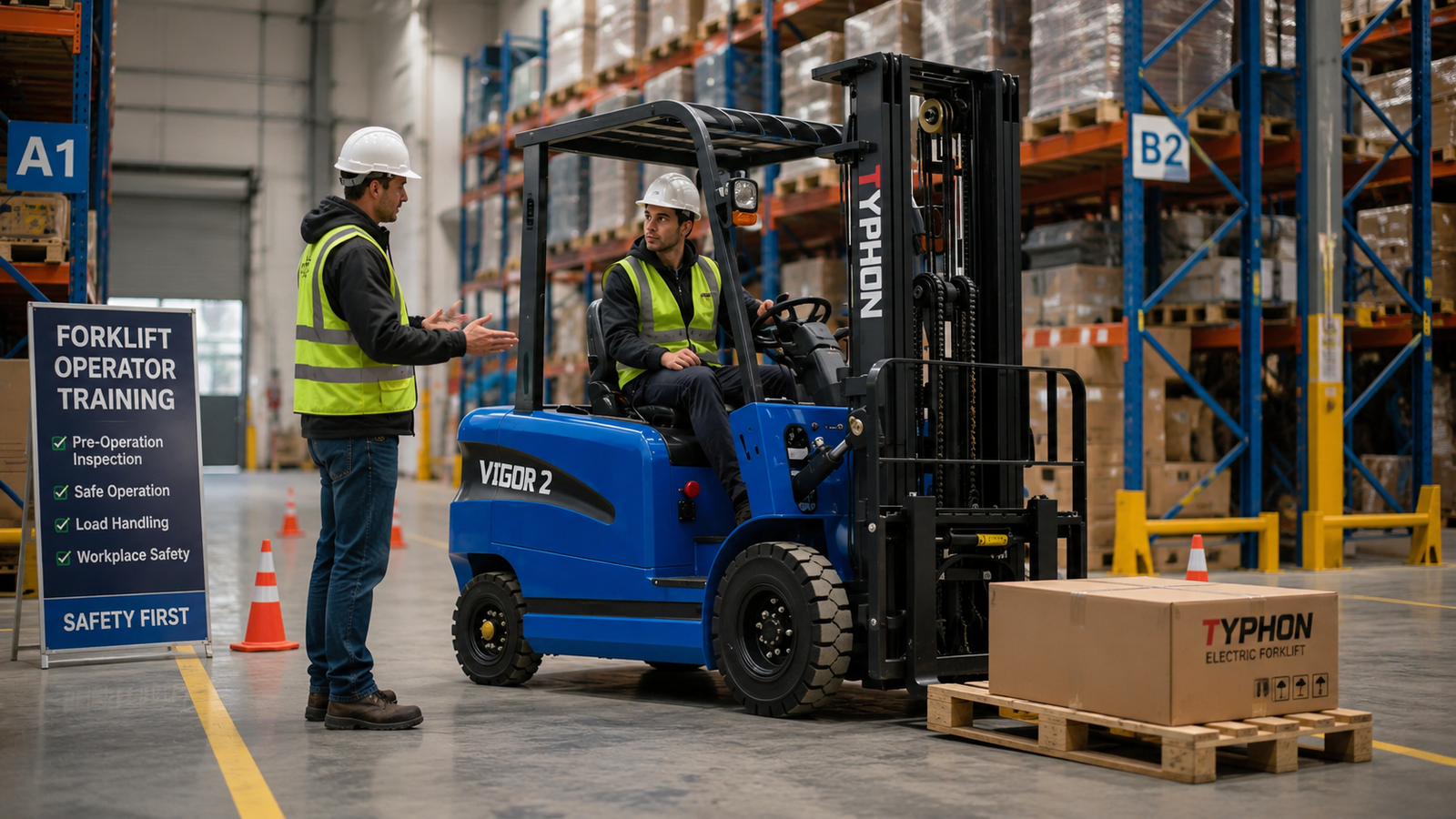
The solution is deliberate, low-pressure practice in an open area before working live. Sit in the seat and identify the directional control, the accelerator, the brake, the lift and lower lever, the tilt control, and the horn. On most machines, you will also find a key switch or keypad, a parking brake, and a display showing battery charge and fault codes. Practice gentle inputs. Ease into the accelerator, feather the lift control, and learn how the steering tightens as you turn. Because rear-wheel steering swings the back of the machine outward during turns, give yourself time to feel how the tail moves.
Building this familiarity early pays off in real, measurable ways. Operators who understand their controls work faster, handle loads more precisely, and avoid the collisions that damage product and racking. That smooth control also protects the equipment from the harsh, jerky inputs that wear components prematurely. Once the controls feel natural, the next habit to build is the daily inspection that keeps the machine safe to operate.
Running a Thorough Pre-Operation Inspection
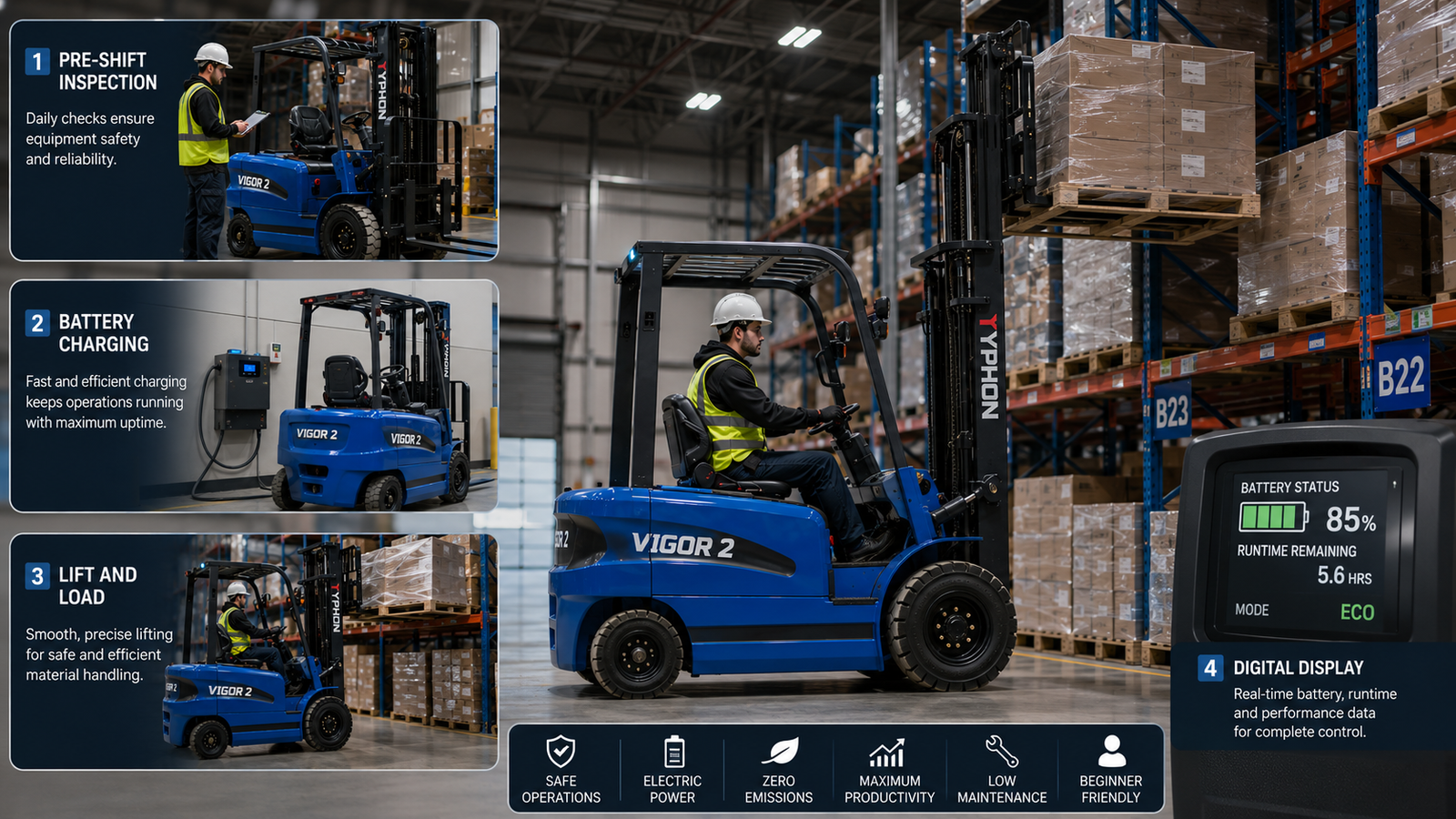
The most reliable operators treat the pre-shift inspection as a non-negotiable ritual, not an optional chore. Before any electric forklift carries its first load of the day, it deserves a careful walk-around to confirm it is safe and ready. Beginners often skip or rush this step, assuming the machine is fine because it worked yesterday. That assumption is exactly how small, fixable issues turn into mid-shift breakdowns or accidents.
The difficulty for new operators is knowing what to look for. A forklift has dozens of components, and without guidance, the inspection can feel like an empty formality. The goal is to check the systems most likely to cause problems: tires, forks, mast, hydraulics, brakes, steering, lights, horn, safety devices, and the battery. Each of these directly affects how the machine performs and how safely it protects you and the people around you.
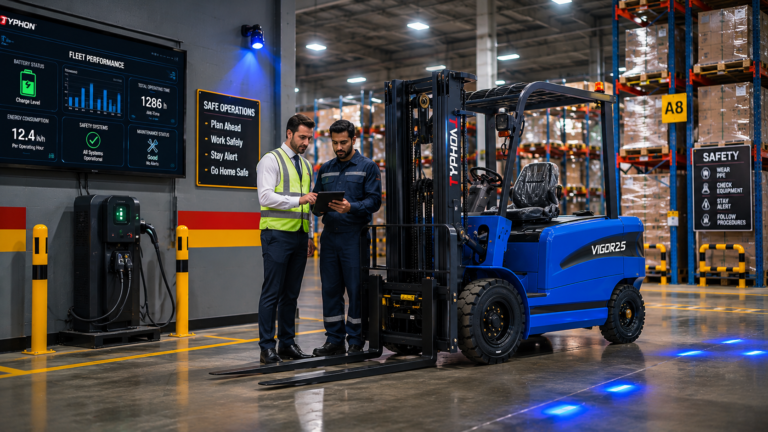
Start with a visual walk-around. Look at the tires for excessive wear, cuts, or flat spots that affect stability. Inspect the forks for cracks or bends, and check the mast chains and hydraulic hoses for leaks or fraying. Confirm the battery is properly connected, charged, and free of corrosion or damaged cables. Then climb in and test the operational items: steering response, service and parking brakes, horn, lights, the seatbelt, and the operator presence system that disables functions when you leave the seat. Raise and lower the mast and tilt it both directions to confirm the hydraulics respond smoothly. If anything looks or feels wrong, report it and tag the machine out of service rather than hoping it holds up.
This discipline delivers a direct return. Catching a low battery, a soft brake, or a leaking hose before the shift starts prevents the costly downtime that disrupts dock schedules and frustrates the entire team. It also protects you from operating a machine that might fail under load. A documented inspection routine builds accountability across shifts and reinforces a culture where safety comes first. With the machine confirmed ready, the next priority is understanding the battery that powers everything you do.
Building Smart Battery Charging Habits
The battery is the heart of an electric forklift, and learning to respect it early sets you apart as an operator. Performance, runtime, and the machine’s long-term value all trace back to how the battery is treated. Beginners frequently overlook this, treating the battery as an afterthought until the machine slows down or dies mid-task. By then, the damage to both productivity and the battery itself may already be done.
The core problem is that different battery types demand different habits, and getting them wrong shortens lifespan dramatically. Many facilities run traditional lead-acid batteries, which require proper watering, full charge cycles, and adequate cooling time. Others use lithium-ion batteries, which thrive on quick opportunity charges during breaks but dislike being left improperly managed for long idle stretches. A beginner who charges the wrong way, or who lets a lead-acid battery run completely flat, can quietly degrade an expensive asset.
The solution is to learn your facility’s specific battery type and follow its charging protocol exactly. For lead-acid systems, avoid interrupting charge cycles, allow the battery to cool, and water it only after a full charge so the fluid does not overflow. For lithium-ion systems, take advantage of short charges during meal breaks to keep the machine topped off throughout the shift. Regardless of chemistry, never operate a forklift while it is plugged in, keep the connectors clean and undamaged, and watch the charge display so you never push the battery to total depletion. Treat the charging area as a designated, organized space rather than a spot to rush through.
Strong battery habits translate directly into reliable performance and lower costs. A well-managed battery holds its capacity longer, powers the machine consistently from the first lift to the last, and spares your operation the expense of premature replacement. For a beginner, this awareness also builds confidence, because you always know how much working time you have left. With the machine inspected and powered, you are ready to focus on moving safely through the warehouse.
Practicing Safe Travel Through the Warehouse
Moving the forklift through a busy facility is where beginner nerves and real hazards meet. Warehouses combine narrow aisles, pedestrians, blind corners, dock traffic, and stacked inventory in a tight footprint. An electric forklift adds a unique wrinkle: it runs so quietly that workers may not hear you coming. Learning to travel safely is one of the most important skills a new operator can develop.
The challenge is that beginners tend to focus too narrowly, watching only the path directly ahead while losing track of everything happening around them. Combined with the instant acceleration of an electric drive, this tunnel vision creates real danger. A pedestrian stepping out of a side aisle, a pallet jack crossing your path, or another forklift backing out of a bay can appear with little warning if you are not actively scanning your surroundings.
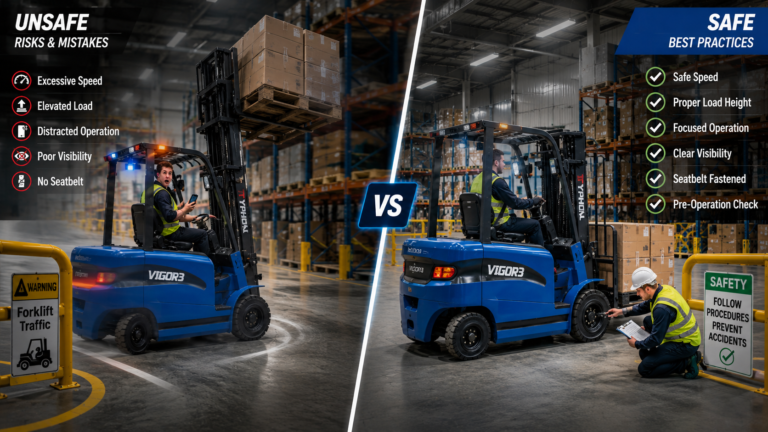
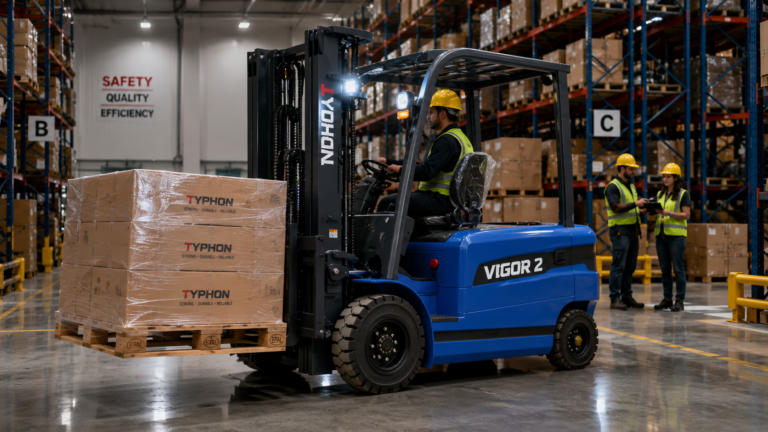
The fundamentals of safe travel are straightforward but require constant discipline. Keep your speed appropriate for the space, slowing well before corners, intersections, and pedestrian zones. Always travel with the forks lowered, roughly four to six inches off the ground, to maintain stability and clear visibility. Sound the horn at blind corners and intersections, and make eye contact with pedestrians whenever possible. When carrying a load that blocks your forward view, travel in reverse so you can see clearly, turning your body to watch the direction of travel. On ramps or inclines, travel with the load pointed uphill to keep it stable. And never allow anyone to walk or stand beneath raised forks.
These habits protect everyone on the floor and keep the operation flowing smoothly. Struck-by incidents are among the most common and serious warehouse accidents, and disciplined travel practices prevent the vast majority of them. Confident, controlled movement also lets you complete tasks faster, because you spend less time correcting mistakes or hesitating at hazards. Once you can move safely, the next skill to master is handling loads with precision.
Mastering Load Handling Basics
Lifting, carrying, and placing loads is the entire purpose of a forklift, and doing it correctly is what separates a productive operator from a liability. Electric forklifts rely on a careful balance between the load, the forks, the mast position, and the machine’s counterweight. For a beginner, understanding this balance is essential, because mishandling a load is one of the fastest ways to tip a machine or drop expensive inventory.
The difficulty lies in respecting the machine’s limits. Every forklift has a rated capacity tied to a specific load center, and exceeding it, or handling a load positioned too far out on the forks, shifts the center of gravity beyond safe limits. New operators often misjudge how an uneven, oversized, or poorly stacked pallet affects stability. They may also raise or lower loads too quickly, causing the material to shift or the machine to rock.
The right technique follows a clear sequence. Approach the pallet squarely and centered, then drive the forks fully into the pallet openings so the weight rests close to the mast. Lift the load just high enough to clear the rack or floor, then tilt the mast slightly back to cradle it securely against the carriage. Travel with the load low and stable. When placing a load, approach slowly, level the forks, position the load precisely over its destination, lower it gently, and withdraw the forks smoothly without dragging. Never exceed the capacity shown on the data plate, and never try to lift a load that looks unstable without first securing or restacking it.
Strong load handling skills protect people, product, and equipment all at once. Stable lifts prevent the tip-overs and falling loads that cause severe injuries and destroy inventory. Smooth, accurate placement reduces rack damage and speeds up storage and retrieval, directly boosting throughput. For a beginner, mastering these basics builds the confidence to handle increasingly demanding tasks. That confidence carries into one of the trickiest skills of all: turning and managing visibility.
Managing Turning, Visibility, and Tight Spaces
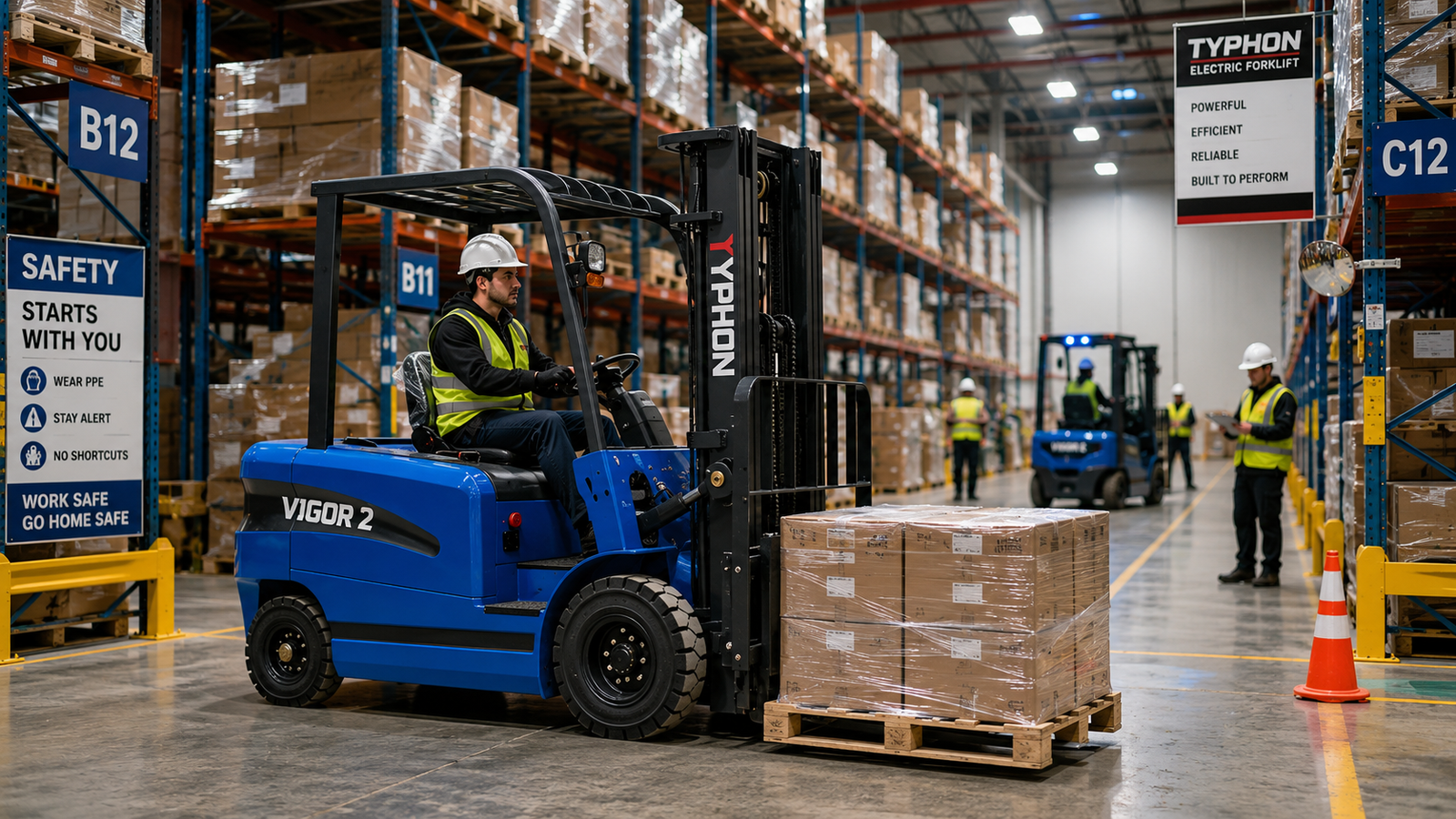
Turning a forklift in a crowded warehouse demands more awareness than many beginners expect. These machines steer from the rear wheels, which means the back end swings wide during turns while the front pivots tightly. New operators who picture a forklift turning like a car are often surprised when the tail end swings into a rack, a wall, or a coworker standing nearby. Combine that with the blind spots created by the mast, the load, and the machine’s frame, and turning becomes a genuine skill to develop.
The limitation is that visibility and maneuverability work against each other in tight spaces. A loaded mast can block your forward view, while the rear-steer design requires room behind you that beginners frequently forget to account for. In narrow aisles and congested staging areas, this combination leads to clipped racking, scraped product, and dangerous near-misses with pedestrians who assume the machine will turn predictably.
Building this skill starts with understanding rear-wheel swing. Before turning, check that the rear of the machine has clearance and that no one is standing in its path. Take corners slowly and widely, giving the tail room to swing without contact. Use your mirrors and any rearview camera consistently, and physically turn to look in the direction you are traveling rather than relying on memory. When your forward view is blocked by a load, travel in reverse. In especially tight or busy areas, slow down, sound the horn, and when available, work with a spotter to guide you through.
Sharp turning and visibility habits keep the operation running cleanly and safely. Avoiding contact with racks, walls, and inventory eliminates the downtime and repair costs that come with collisions. Smooth maneuvering through tight spaces also keeps material flowing quickly, which protects your facility’s productivity. As your awareness grows, the final habit to lock in is how you finish the job: parking and shutting down correctly.
Parking, Shutdown, and Beginner Mistakes to Avoid
How you end a shift reveals as much about your skill as how you start it. Beginners are often eager to climb out and finish for the day, but a hurried, careless shutdown creates hazards and shortens equipment life. A forklift left in the wrong place, with forks raised or the battery mismanaged, becomes a danger to the next person and a problem for the whole operation.
The risk is that an improperly parked machine invites accidents. Forks left elevated can slowly drift down and crush whatever sits beneath them. A machine parked in a travel lane, near a dock edge, or blocking an emergency exit creates obstacles and safety violations. Leaving the key in an unattended forklift allows untrained people to move it. These oversights feel minor in the moment but carry serious consequences.
The correct shutdown sequence is simple and worth following every time. Park on level ground, away from traffic lanes, ramps, dock edges, and exits. Lower the forks completely until they rest flat on the floor, then set the mast to neutral. Apply the parking brake, turn off the machine, and remove the key or log out of the keypad. If the battery needs charging, connect it according to your facility’s protocol. Finally, give the machine a quick look for any issues to report before you walk away.
A few common beginner mistakes deserve special attention. Watch out for these habits as you learn:
Skipping the pre-operation inspection because the machine seemed fine yesterday
Traveling with the forks raised, which hurts stability and visibility
Accelerating or braking too hard with the instant electric drive
Exceeding the rated capacity or lifting an unstable load
Forgetting that the rear of the machine swings wide during turns
Letting the battery run completely flat or charging it incorrectly
Leaving forks raised or the key in the machine when parking
Avoiding these pitfalls protects you, your coworkers, and the equipment while accelerating your growth as an operator. Disciplined shutdowns and self-awareness around common errors keep the machine ready for the next shift and reinforce the professional habits that define a trusted operator.
Conclusion
Learning to operate an electric forklift comes down to mastering a set of fundamentals and practicing them until they become second nature. When you understand the controls, run thorough inspections, manage the battery with care, travel and turn safely, and handle loads with precision, the machine stops feeling intimidating and starts feeling dependable. Each of these skills reinforces the others, building the confidence, safety, and efficiency that make a productive operator.
For new operators and the teams that support them, the next step is simple: commit to these habits from the very first shift and refuse to cut corners as the days get busier. Pair this knowledge with hands-on training and proper certification, ask questions whenever you are unsure, and treat every safe, smooth shift as proof that the fundamentals work. Build that foundation now, and you will operate with the kind of confidence and reliability that strengthens your entire warehouse for years to come.