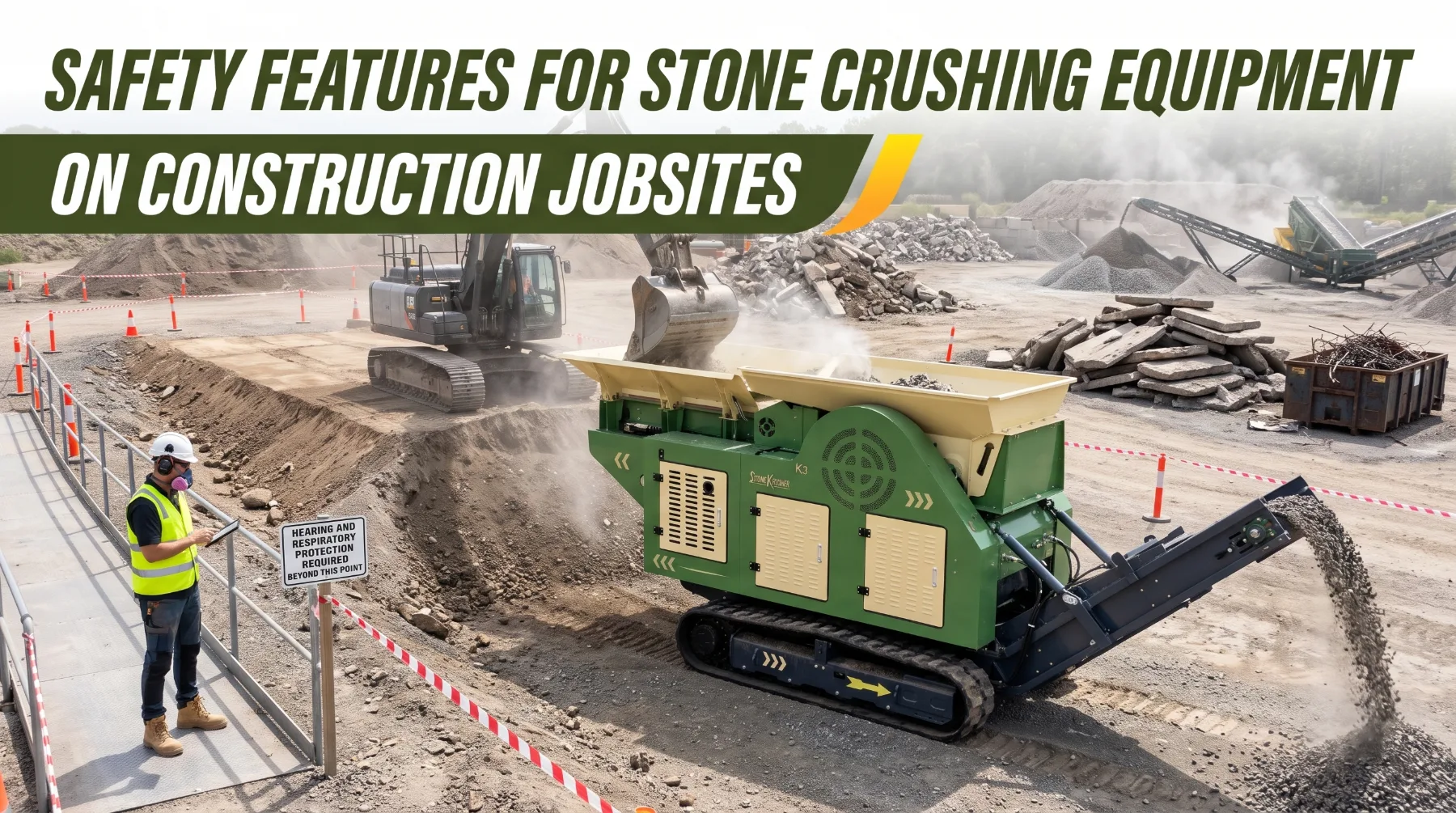
A stone crusher concentrates enormous force in a small space. Rock enters the feed hopper, gets broken between crushing surfaces, and leaves on conveyors moving tons of material every hour. Flywheels, belts, pulleys, rotors, and hydraulic systems power every stage. The same force that turns blasted rock or demolition concrete into usable aggregate can cause severe injury if a worker reaches into the wrong place, stands in the wrong spot, or starts work before the machine is fully isolated.
Most serious crusher incidents follow familiar patterns. A worker clears a blockage while the feeder is still live. A guard removed for maintenance never goes back on. Someone shovels spillage beside a moving conveyor and gets caught at a tail pulley. A rock ejected from the feed opening strikes a person standing too close. In nearly every case, the hazard was predictable, and a safety feature or procedure was available to control it.
Modern crushing equipment includes a range of protective systems designed for these hazards. Emergency stops, fixed and interlocked guards, protected feed areas, conveyor pull-wires, dust suppression, and lockout points all reduce exposure to moving parts and stored energy. These features only work when crews understand them, keep them in working order, and never bypass them to keep production moving.
Emergency Stop Controls and Shutdown Systems
Emergency stop controls let anyone near the machine stop hazardous motion quickly when something goes wrong. On mobile and stationary crushers, emergency stop buttons are typically placed at the main control panel, near the feed area, at access walkways, and along conveyors. Many conveyors also carry pull-wire or lanyard switches running along their length, so a worker can stop the belt from almost any point beside it. Remote and wireless controls on many tracked crushers include their own emergency stop function.
Every worker on the crushing site should know where each emergency stop is located before the plant starts. Walk new crew members around the machine during their site induction and point out each button and pull-wire. Make sure the controls stay visible and reachable. Stockpiled material, parked equipment, or stored parts should never block access to an emergency stop.
What an emergency stop does and doesn’t do
An emergency stop is designed to halt hazardous motion as fast as the machine safely can. It isn’t an isolation device. Pressing it doesn’t remove stored hydraulic pressure, doesn’t necessarily isolate every electrical circuit, and doesn’t stop heavy rotating parts instantly. A jaw crusher flywheel or an impact crusher rotor can keep turning for some time after the drive stops. Workers must confirm that all relevant components have come to a complete stop before approaching the machine, and must still follow full lockout before any work inside guarded areas.
Emergency stops also aren’t a substitute for normal shutdown. Routine stops should follow the manufacturer’s sequence, which typically stops the feeder first, lets the crusher clear, and then stops conveyors. That sequence prevents material from being trapped in the chamber or piled onto stopped belts.
Interlocks and start-up warnings
Many plants include interlocks that link the feeder, crusher, and conveyors. If a downstream conveyor stops, the feeder and crusher stop automatically so material doesn’t back up. Start-up warnings, such as horns and flashing beacons, give people time to move clear before equipment begins to move. Never bypass interlocks, tape down switches, or disable start-up alarms to save time.
Test emergency stops and pull-wires at the frequency the manufacturer specifies, often during the pre-shift inspection. After using an emergency stop, find out why it was needed before resetting it. Reset should only happen once the cause is corrected and everyone is clear.
Key takeaway: Know the location of every emergency stop and pull-wire, keep them accessible and tested, remember they don’t isolate stored energy or stop rotating parts instantly, and never bypass interlocks or start-up warnings.
Guards for Belts, Pulleys, and Moving Components
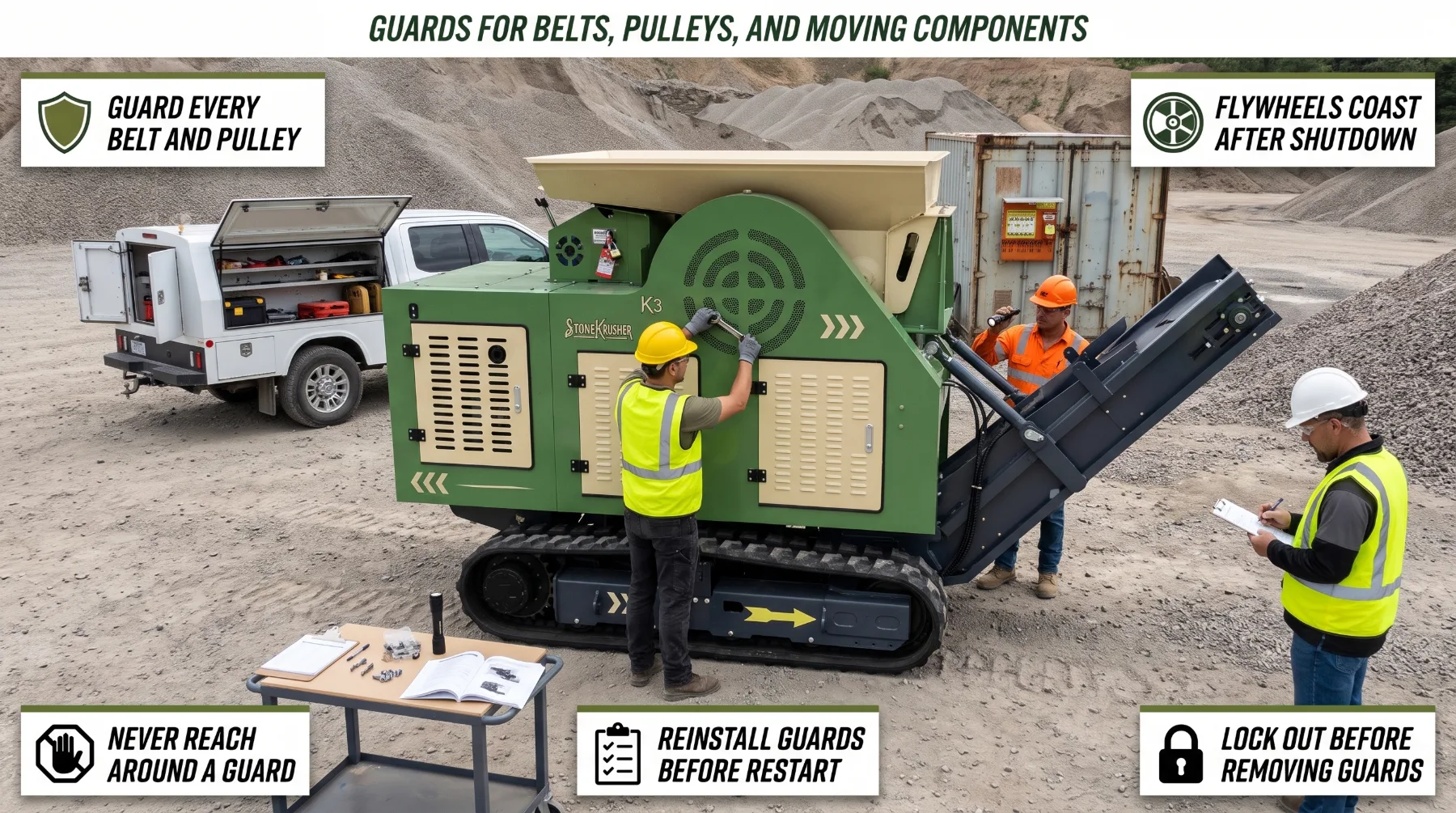
Crushers rely on drive belts, pulleys, flywheels, shafts, couplings, and chains to transmit power. Each one creates entanglement, nip point, and crushing hazards. A loose sleeve, glove, or rag caught in a belt drive can pull a hand or arm into the machine in a fraction of a second. Guards place a physical barrier between people and these parts during normal operation.
Most guards on crushing equipment are fixed guards, bolted or secured so they can only be removed with tools. Some access panels use interlocked guards that stop the machine or prevent starting when they’re opened. Both types are designed to protect workers who are close to the machine for normal tasks such as inspection rounds, operating the controls, or monitoring material flow.
Where guards matter most
Pay particular attention to these areas during inspections:
Flywheels and drive belts on jaw and impact crushers, which carry high energy and coast after shutdown
Head, tail, and snub pulleys on conveyors, where belts create in-running nip points
Return idlers and take-up assemblies, which can trap hands and clothing
Drive shafts, couplings, and chains on feeders, screens, and hydraulic pumps
Vibrating screen drives and exciter mechanisms
Guards must cover the hazard fully. A guard that leaves a gap large enough for fingers or hands to reach a moving part doesn’t provide real protection. Check that guards are secure, undamaged, and fitted with all their fasteners.
Keeping guards in place
Guards must never be removed, opened, or reached around while the machine is running. Removing a guard is a maintenance task that requires full isolation and lockout first. Before returning the crusher to service, every guard must be reinstalled and secured. Supervisors should confirm guards are in place during the restart check, since a single missing guard after a repair can expose the whole crew.
Never use a guard as a step, shelf, or support for tools. Report damaged or missing guards immediately and keep the machine out of service until they’re replaced. Workers near moving equipment should avoid loose clothing, dangling lanyards, and unsecured long hair.
Key takeaway: Keep fixed and interlocked guards securely installed over every belt, pulley, flywheel, and drive, never remove or reach around them while the machine runs, and confirm every guard is back in place before restart.
Feed Hopper and Material Entry Protection
The feed hopper is where heavy rock meets moving equipment, and it’s one of the most hazardous areas on any crushing site. Workers near the feed area may be exposed to falling material, rock ejected from the crushing chamber, swinging excavator buckets, and the sudden movement of bridged or jammed rock. Hopper design and loading procedures work together to keep people out of harm’s way.
Protective design features
Many crushers include raised hopper extensions or side plates that help contain material during loading. Grizzly feeders and pre-screens separate fines before they reach the chamber. Some feed openings use chain curtains or rubber flaps to reduce the chance of rock fragments flying out. On primary installations, a pedestal-mounted rock breaker positioned over the feed opening lets an operator break bridged or oversized rock from a protected control position. Some mobile jaw crushers also include hydraulic chamber-clearing or reverse functions for releasing jammed material. Use these only as the manufacturer instructs.
Loading platforms need protection as well. Where an excavator or loader feeds from a raised pad, the pad should be stable, wide enough for the machine, and fitted with edge berms or barriers. That keeps the loading machine from approaching the hopper edge too closely.
Safe feeding practices
Feed material according to the crusher’s maximum feed size and operating limits. Oversized rock and slabs can bridge across the opening or jam the chamber, creating exactly the kind of blockage that tempts people to intervene. Break oversized material on the ground with a hydraulic breaker before loading, and set aside slabs that won’t feed cleanly.
Tramp metal deserves equal attention. Rebar, bucket teeth, steel plate, and other uncrushable objects can jam crushing surfaces, damage components, and in some cases be ejected with force. Use an overband magnet, metal detection where fitted, and manual picking on recycling jobs. Many cone crushers include hydraulic tramp release systems that let uncrushable objects pass. Keep these systems maintained and never adjust their settings outside the manufacturer’s procedure.
Rules that keep people safe
Clear rules protect everyone near the hopper. Never reach into the feed opening or crushing chamber while the crusher is running or capable of moving. Never stand on material in the hopper, and never use a bar, hand tool, or improvised lever to free a bridged rock from the hopper edge. Keep everyone out of the swing radius of the loading machine and away from the hopper sides during feeding. Never stand beneath a suspended load or a raised bucket.
Entering a hopper or crushing chamber is a high-risk task that may involve fall hazards and confined space requirements. It requires full lockout, the manufacturer’s approved procedure, suitable fall protection, permits where site rules require them, and authorized personnel only.
Key takeaway: Use protective hopper features and approved clearing tools, keep feed within the maximum size, remove tramp metal before it reaches the crushing surfaces, and never reach into the feed opening or stand on material in the hopper.
Conveyor Safety and Material Discharge Areas
Conveyors move crushed material from the crusher to screens, stacking conveyors, and stockpiles. Because belts operate continuously and often run alongside elevated walkways, workers can be exposed to moving parts during routine activities. Common hazards include reaching near tail pulleys, cleaning spillage beneath return idlers, and removing material buildup around transfer points. Proper guarding should cover head, tail, and drive pulleys, take-ups, and accessible return idlers. Pull-wire emergency stops allow workers to stop the belt quickly, while belt scrapers and transfer-point skirting help reduce material carryback and spillage.
Regular conveyor maintenance is essential for keeping these safety features effective. Test pull-wire emergency stops according to the manufacturer’s instructions, inspect pulley guards, and adjust scrapers and skirting during scheduled maintenance. Walkways should have secure footing, handrails, toe boards, and safe ladder access to elevated sections. Repair damaged platforms promptly and remove accumulated spillage to prevent slip hazards and reduce the need for workers to approach moving components.
Workers must never clean, shovel, or remove blockages beside a running conveyor. Stop the equipment, isolate its energy sources, and apply lockout procedures before clearing spillage near pulleys or idlers, removing blocked material from chutes, or making manual belt adjustments. Never walk on, step over, or reach across a moving belt. Use designated crossover bridges with guardrails or properly guarded crossing points whenever workers need to pass between conveyor sections.
The discharge area also requires careful planning to maintain safe material flow and separate people from mobile equipment. Position stockpiles so crushed material can leave the conveyor freely, and move accumulated product before it reaches the head pulley and restricts discharge. Workers should never stand at the base of an active stockpile or walk on loose material that could shift or collapse. Loaders need clear operating routes away from conveyor supports and pedestrian walkways, while barriers and marked access routes help keep workers separated from loading activities.
Key takeaway: Keep conveyor guards, pull-wires, scrapers, and walkways in good condition, lock out before cleaning or clearing material near belts, and manage stockpiles so they never reach the discharge or bury access routes.
Dust Control, Noise Protection, and Operator Visibility
Enclosed operator cabs with filtered, pressurized air provide additional protection where available, while regular housekeeping helps prevent dust from accumulating around walkways and equipment. Use wet cleaning methods or suitable filtered industrial vacuums instead of dry sweeping or compressed air. If engineering controls cannot adequately reduce silica exposure, employers should provide appropriate respiratory protection based on exposure assessments, supported by fit testing, training, and a respiratory protection program.
Crushers, screens, engines, and falling rock generate substantial noise that can cause permanent hearing damage over time. Workers should wear properly fitted earplugs or earmuffs in designated high-noise areas, with warning signs clearly identifying hearing protection zones. Lighting also plays an important role in safe operation, particularly around walkways, control stations, access ladders, and material feeding areas. Keep windows, mirrors, and cameras on loaders and other mobile equipment clean to maintain clear sightlines. Two-way radios or agreed hand signals help crusher and loader operators coordinate movements when machinery noise makes verbal communication difficult.
Key takeaway: Control silica dust with water sprays, enclosed cabs, and wet cleaning first, provide respirators and hearing protection based on exposure assessments, and maintain lighting and reliable communication around the plant.
Lockout Procedures and Maintenance Protection
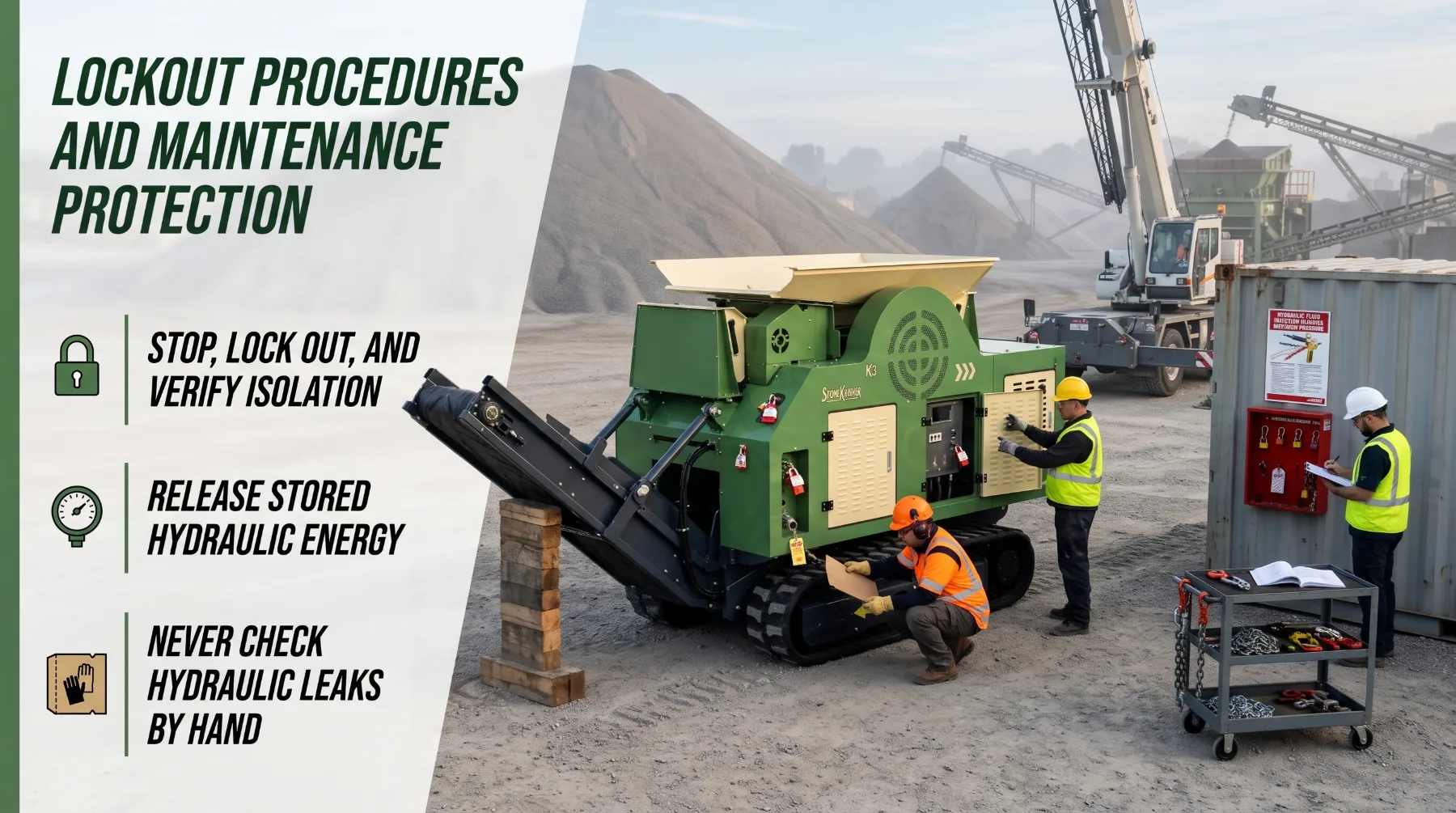
Maintenance exposes workers to hazards that guards and emergency stops are designed to keep out of reach during normal operation. Changing wear parts, clearing blockages, adjusting belts, and inspecting crushing surfaces all put people inside the machine’s danger zones. Lockout and tagout is the safety procedure that makes this work possible without risking unexpected movement.
Stored energy and heavy components
Stopping the engine doesn’t remove every source of energy. Hydraulic systems used for setting adjustment, tramp release, chamber clearing, and conveyor folding can hold pressure after shutdown. Raised conveyors, hopper extensions, and access doors can move under gravity. Rock jammed in a chamber holds energy of its own and can shift once disturbed. Support raised components with the manufacturer’s approved devices, and stayed out of the line of fire when releasing jammed material.
Wear parts such as jaw plates, mantles, concaves, and blow bars are heavy and can move unexpectedly during removal. Use the manufacturer’s approved lifting tools and properly rated lifting equipment, and keep hands and bodies clear of pinch points.
Hydraulic inspection safety
Inspect hydraulic hoses, fittings, and cylinders during scheduled checks. Common causes of hydraulic leaks include worn or cracked hoses, loose fittings, damaged seals, corroded connections, and excessive system pressure. Never use your hand to search for a hydraulic leak. Fluid escaping through a pinhole under pressure can penetrate the skin and cause an injection injury. The wound may look minor at first, but it’s a medical emergency that requires immediate surgical treatment. Use a piece of cardboard or wood to locate leaks, and wear gloves and eye protection. If anyone is struck by escaping fluid, get emergency medical care at once and tell medical staff it’s a hydraulic injection injury.
Qualified personnel and restart
Only trained, authorized personnel should perform maintenance and repairs on crushing components, drives, hydraulics, and electrical systems. Before restart, confirm that tools are removed, every guard is reinstalled, all workers are clear, and each person has removed their own lock. Then sound the start-up warning and follow the manufacturer’s start sequence.
Key takeaway: Lock out every energy source before maintenance, release or secure stored hydraulic and gravity energy, check hydraulic leaks with cardboard rather than your hands, use approved lifting tools, and restart only after guards are back and everyone is clear.
Conclusion
Stone crusher safety depends on several connected layers of protection. Emergency stops and pull-wires let crews halt motion quickly, while fixed and interlocked guards keep hands and clothing away from belts, pulleys, and flywheels. Protected feed areas, controlled feeding, and tramp metal removal reduce hazards at the hopper. Guarded conveyors, organized discharge areas, and managed stockpiles protect workers around material flow. Dust suppression, silica controls, hearing protection, and good visibility address the health and communication hazards of crushing, and disciplined lockout keeps maintenance work safe.
Frequently Asked Questions
What are the most important safety features on a stone crusher?
Key features include emergency stop buttons at the control panel, feed area, and walkways, along with pull-wire stops on conveyors. Fixed and interlocked guards over belts, pulleys, flywheels, and drives are essential. Protected feed hoppers, remote rock breakers or clearing functions, tramp metal removal, dust suppression systems, start-up warnings, and clearly marked lockout points complete the system. Use the features the manufacturer specifies and keep them maintained and tested.
Why are conveyor guards necessary on crushing equipment?
Conveyors create in-running nip points at head, tail, and drive pulleys, take-ups, and return idlers. A hand, glove, or loose clothing caught at one of these points can be pulled into the machine in an instant, causing severe crushing or amputation injuries. Guards create a physical barrier during normal operation. They must stay securely installed, and any work near belts requires the conveyor to be stopped and locked out first.
Should workers enter a crusher feed hopper to remove blocked material?
No, not as part of normal operation. Workers must never reach into or enter the feed hopper or crushing chamber while the machine is running or capable of moving. Use approved methods first, such as a remote rock breaker or the manufacturer’s clearing function. If entry is unavoidable, it requires full lockout, release of stored energy, the manufacturer’s approved procedure, suitable fall protection, any required permits, and authorized personnel only.
How can contractors reduce dust exposure during crushing?
Start with engineering controls. Keep water spray bars working at the feed, discharge, and transfer points, use enclosed cabs with filtered air where available, and clean with wet methods or suitable vacuums instead of dry sweeping. Many rock types contain crystalline silica, so assess worker exposure against applicable limits. Where controls aren’t enough, provide fitted respirators under a respiratory protection program, along with training on silica hazards.