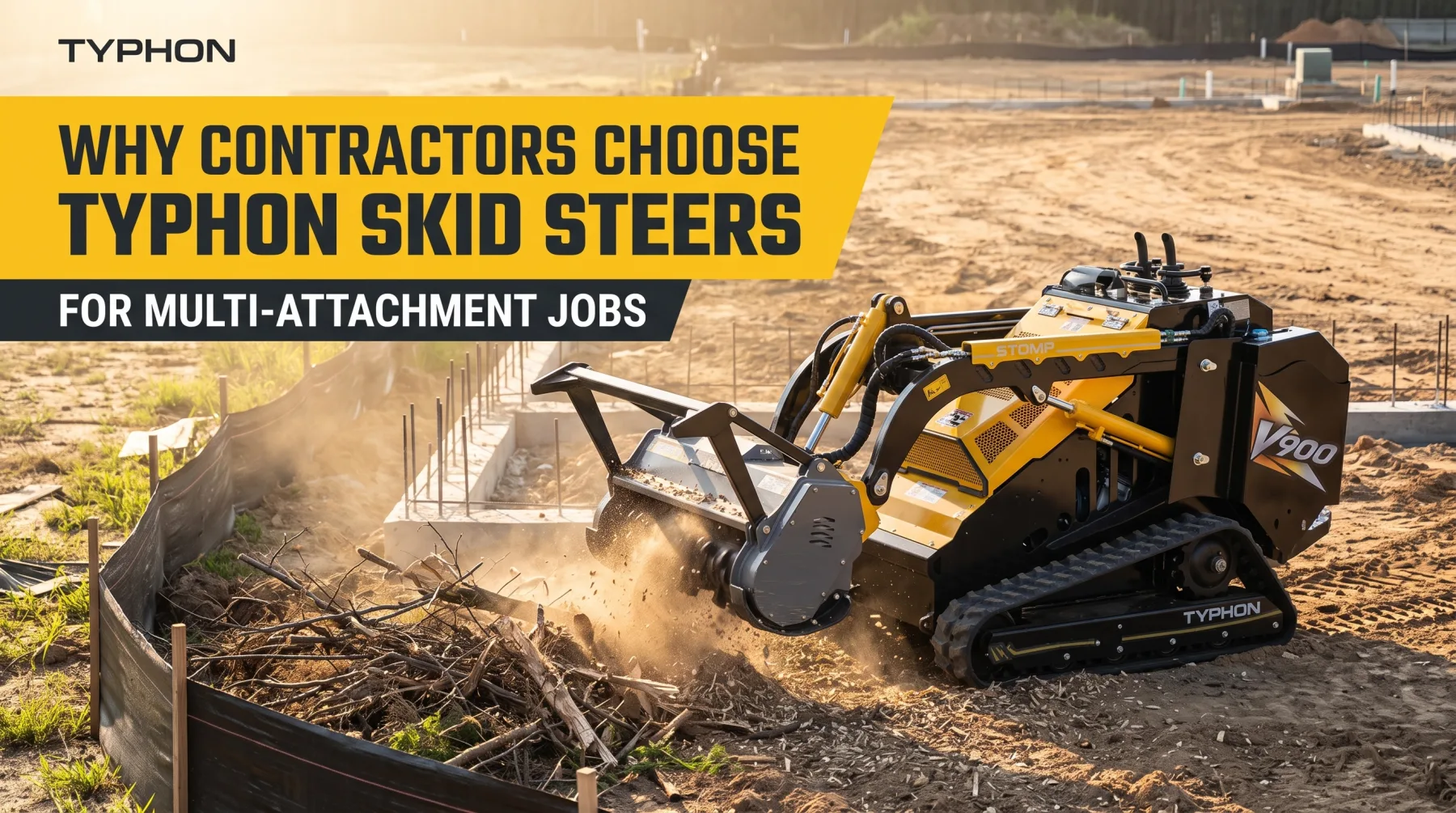
A site contractor lands a mixed-scope project that sprawls across a single lot: dig footings one morning, mulch a fence line the next, then grade, auger post holes, and haul debris before the week wraps. He rolls in with a machine that handles a bucket well enough but chokes the moment he mounts a mulcher, starving the tool on standard flow until it stalls. Rather than run one unit through the whole job, his crew shuttles between two machines and a rental, burning fuel and hours on a project that should have flowed through a single workhorse. By Friday he’s tallying the cost of a machine that couldn’t keep up with the tools the job demanded. That bottleneck is exactly why so many crews rethink which skid steer they trust for multi-attachment work.
Running a full slate of attachments off one skid steer takes a machine built for it, not one that merely tolerates a bucket. TYPHON skid steers earn their spot on multi-tool job sites by pairing the hydraulic muscle, coupler flexibility, and durability that swapping tools all day actually demands. This guide walks through why these machines fit multi-attachment work, how their hydraulic flow and coupler design drive versatility, what makes them hold up under daily use, the range of tools they run, the productivity they unlock, and how to match the right model to your jobs. Here’s what to weigh before you commit a machine to a tool-heavy schedule.
What Makes One Machine Handle Many Tools
Versatility is the whole reason a contractor buys a skid steer instead of a single-purpose machine, and TYPHON builds its units around that idea. One machine supplies the power, the hydraulics, and the coupler, while the tool you mount decides whether the day means digging, grading, mulching, or hauling. Backed by a rack of attachments, a single TYPHON covers work that would otherwise scatter across a small fleet.
Fit to real job sites is where these machines separate themselves. A crew running five different tools across a week needs a unit that swaps between them cleanly, feeds each one the flow it wants, and shrugs off the wear that constant changes bring. Skid steers built for that rhythm keep a job moving; ones that don’t leave a contractor juggling machines.
Key takeaway: A TYPHON skid steer works as a single power source for many tools, so its value climbs with every attachment you run. Match one machine to a tool-heavy job, and you replace the shuffle between units with a clean, single-machine workflow.
Hydraulic Flow That Feeds Every Attachment
Power to the tool starts with hydraulic flow, and it’s where cheaper machines quietly fall short. Every powered attachment, from a mulcher to a cold planer to a large auger, needs a certain flow rate and pressure to perform, and a unit that can’t deliver it just chatters and stalls. TYPHON machines carry the auxiliary hydraulics to drive demanding tools at full performance rather than starving them halfway through a pass.
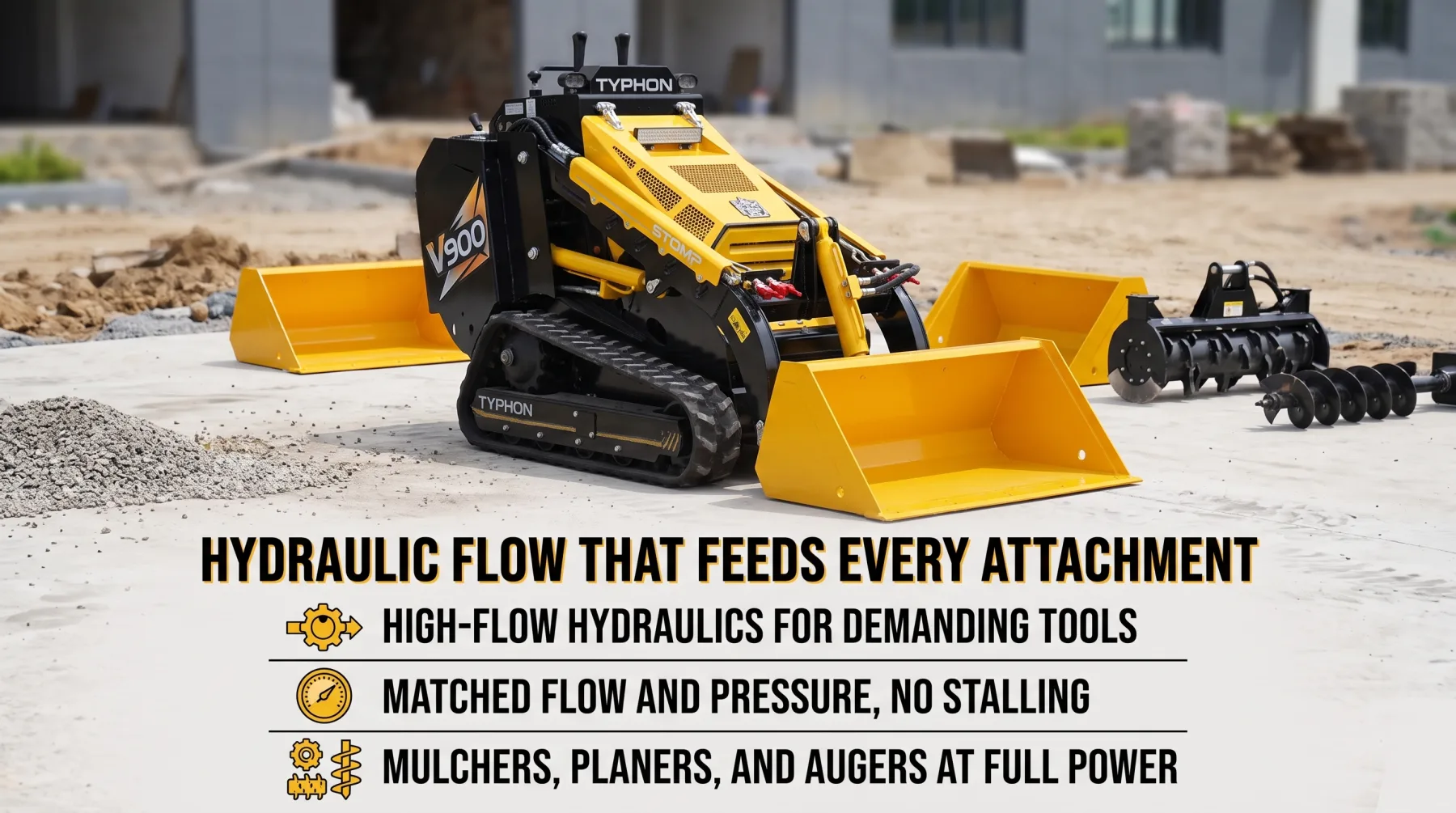
High-flow capability opens the door to the heaviest attachments a contractor runs. Where a standard-flow-only machine bogs down on a mulcher or a planer, a high-flow TYPHON pushes the tool the way it was designed to work, turning a rented specialty attachment into a productive part of the day. Matching the machine’s output to your thirstiest tool is what keeps that tool earning its keep.
Steady pressure under load rounds out the picture. A machine that holds its flow while the tool digs in finishes the pass instead of losing power at the worst moment, so consistent hydraulics translates straight into consistent work.
What this means: Confirm the flow rating against your most demanding attachment before you commit, and a TYPHON’s hydraulic muscle drives the tool at full performance rather than starving it. Steady flow under load is what separates a machine that runs your tools from one that fights them.
A Coupler Built for Fast, Clean Swaps
Tool changes eat time on multi-attachment jobs, so the coupler matters as much as the engine. TYPHON skid steers use a universal quick-attach plate that lets an operator drop one tool and lock on the next in under a minute, without leaving the cab for most swaps. That speed adds up across a day of digging, then grading, then augering, then hauling.
Compatibility with the wider attachment market is the quiet advantage here. Because the universal plate matches the industry-standard pattern, a contractor can run tools from many suppliers rather than being locked into one brand’s catalog, which keeps both the machine and the budget flexible. Owning a machine that accepts the tools you already have beats buying a whole new set.
Secure locking protects both the operator and the pace of work. A coupler that seats and holds the tool firmly means no mid-job wobble or dropped attachment, so the crew swaps with confidence and gets straight back to the task.
Key takeaway: A TYPHON’s universal quick-attach coupler swaps tools in seconds and accepts the broad range of standard attachments you already run. Fast, secure changes keep a tool-heavy day flowing instead of stalling at every switch.
Built to Take Daily Job Site Punishment
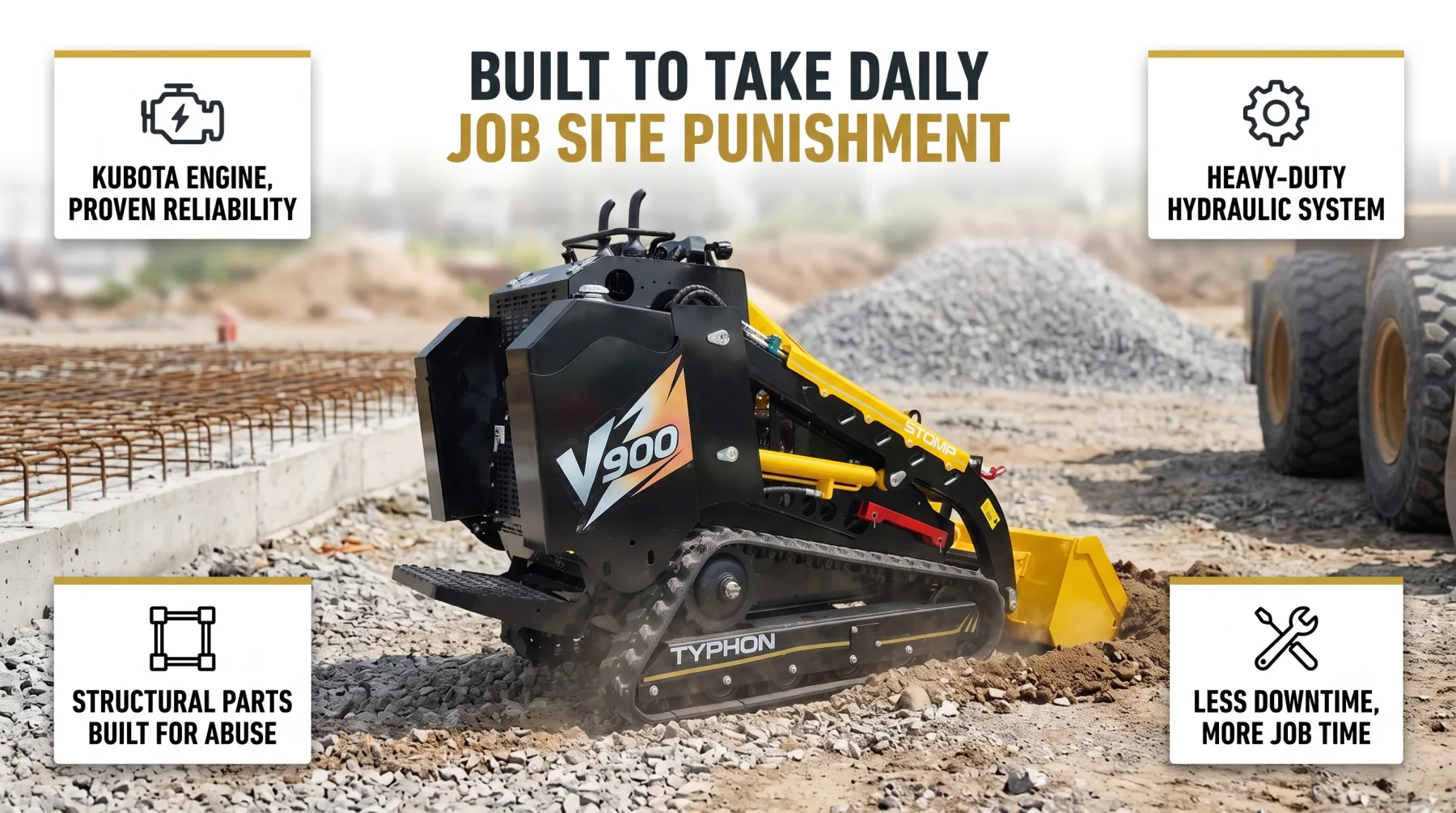
Durability decides whether a machine that runs many tools survives the strain, since every swap and every heavy attachment tests the frame and hydraulics. TYPHON skid steers pair a Kubota engine with a sturdy build meant for the repeated loading, ripping, and hammering that multi-attachment work throws at a unit. Reliability like that keeps a machine on the job instead of in the shop, where downtime costs far more than any single repair.
Proven components carry a lot of that reliability. Engines with a long track record, robust hydraulic systems, and heavy-duty structural parts hold up under the constant demands a busy contractor puts on them, so the machine that dug this morning still mulches strong this afternoon. Equipment that shrugs off hard use protects both the schedule and the investment.
Simple, accessible maintenance stretches that dependability further. Machines built so a crew can check fluids, grease points, and wear parts without a fight stay healthy across a long season, and easy upkeep means small issues get caught before they sideline the unit.
What this means: A TYPHON is built with a proven engine and a rugged frame to absorb the daily strain of multi-tool work, so it keeps running when a lighter machine would fail. Reliability and easy upkeep protect your schedule and your investment shift after shift.
The Range of Tools You Can Actually Run
Attachment breadth is what turns one skid steer into an entire tool kit, and TYPHON machines run the full spread contractors reach for. Buckets trench and load, forks move pallets, augers drill post and footing holes, grapples grab brush and debris, and mulchers and planers tackle land clearing and surface work. Each tool changes what the machine does, so a single unit covers digging, hauling, grading, drilling, and clearing across one project.
Powered and non-powered tools both find a home on these machines. Simple attachments like buckets and forks rely on the machine’s lift and drive, while powered tools tap the auxiliary hydraulics, and a TYPHON handles both without missing a beat. Running the whole mix off one coupler is exactly what a multi-scope job demands.
Specialty tools extend the reach even further. Tilt buckets, trenchers, and rakes fill niche tasks that come up mid-project, and a machine that accepts them keeps a contractor from renting a separate unit for every odd job.
Key takeaway: A TYPHON skid steer runs the everyday tools and the specialty ones alike, from buckets and forks to mulchers and planers. Owning one machine that accepts the full range turns a tool-heavy project into single-unit work.
Where the Productivity Payoff Shows Up
Time saved on the job site is the clearest return a contractor sees, since one machine that swaps tools quickly beats shuttling between several. Rather than trailering a separate unit for every task, a crew runs the whole scope through a single TYPHON, cutting the hauling, staging, and idle time that a multi-machine approach demands. Hours reclaimed that way flow straight into finishing jobs sooner.
Cost control follows close behind the time savings. Investing in one versatile machine and a rack of attachments spreads a single purchase across every task, rather than buying or renting a dedicated unit for digging, another for mulching, and a third for hauling. Fuel, transport, and maintenance all shrink when one machine carries the load.
Bidding confidence rounds out the payoff. A contractor who knows one machine covers the full scope of a mixed job quotes it cleanly, schedules the crew around a single unit, and takes on tool-heavy work others turn down for lack of the right equipment.
What this means: One TYPHON running many tools trims hauling, idle time, and duplicate equipment cost, so productivity climbs while overhead drops. That single-machine reach lets you bid tool-heavy jobs with confidence and finish them faster.
Matching the Right Model to Your Work
Job type points you toward the right machine faster than any spec sheet, so picture the work you repeat most. Tight residential lots, hardscape jobs, and turf-sensitive sites reward a compact TYPHON that fits gates and spares finished ground, while open commercial pads and heavy loading call for a larger-frame unit with the capacity and power to match. Naming the work first narrows the field to models that actually fit it.
Rated capacity and horsepower settle the size question next. Confirm the machine lifts your heaviest routine load safely and carries the engine power to push through the material you work most, since a unit rated too light strains while one rated too heavy costs more than the job needs. Reading those numbers against your real tasks keeps the choice honest.
Hydraulic flow ties the decision to your tools. If your work leans on mulchers, planers, or large augers, confirm the model offers the high flow those attachments demand, because a machine that can’t feed your heaviest tool leaves it stalled. Weighing frame size, capacity, power, and flow together lands you on the model that fits both your site and your attachment lineup.
Key takeaway: Match the TYPHON model to your jobs by weighing frame size, rated capacity, horsepower, and hydraulic flow against the work and tools you run most. Let those realities guide the pick rather than chasing the biggest machine on the lot.
Conclusion
Choosing a TYPHON skid steer for multi-attachment work comes down to one machine that genuinely handles many tools rather than merely tolerating a few. These units pair the hydraulic flow to drive demanding powered attachments, a universal coupler that swaps tools in seconds, and a durable, Kubota-powered build that absorbs daily job site strain. Because they run the full range of buckets, forks, augers, grapples, mulchers, and specialty tools off a single coupler, one machine covers a mixed-scope project that would otherwise scatter across a fleet, trimming hauling, idle time, and duplicate equipment cost along the way. Match the model to your work by weighing frame size, rated capacity, horsepower, and hydraulic flow against the jobs and tools you repeat most, then let those realities steer the choice. Picture your tightest site, your heaviest load, and your most demanding attachment, and the right TYPHON becomes clear. When you’re ready to put a dependable, well-matched TYPHON skid steer to work on your tool-heavy jobs, reach out to a trusted equipment specialist who can pair a reliable machine with the results your projects depend on.
Frequently Asked Questions
Why are TYPHON skid steers good for running multiple attachments? These machines are built around versatility, pairing the auxiliary hydraulic flow that powered tools demand with a universal quick-attach coupler that swaps attachments in seconds. A proven Kubota engine and rugged frame absorb the strain of constant tool changes and heavy use, so one machine runs buckets, forks, augers, grapples, mulchers, and more across a single project. That combination lets a contractor cover a mixed-scope job with one unit instead of shuttling between several.
What hydraulic flow do I need to run powered attachments on a TYPHON skid steer? It depends on the tool. Simple attachments like buckets and forks rely on the machine’s lift and drive, so they don’t need auxiliary flow. Powered tools such as augers and grapples run on standard flow, while demanding attachments like mulchers, cold planers, and large augers require high flow to perform. Confirm the model’s flow rating against your most demanding tool before you commit, since a high-flow attachment stalls on a machine that can’t feed it.
How do I choose the right TYPHON model for my jobs? Start with the work you repeat most. Tight residential and turf-sensitive sites suit a compact model that fits gates and spares finished ground, while open commercial work and heavy loading call for a larger frame with more capacity and power. Confirm the rated operating capacity meets your heaviest load, the horsepower suits your material, and the hydraulic flow drives your most demanding attachment. Weighing those four factors together lands you on the model that fits both your site and your tool lineup.