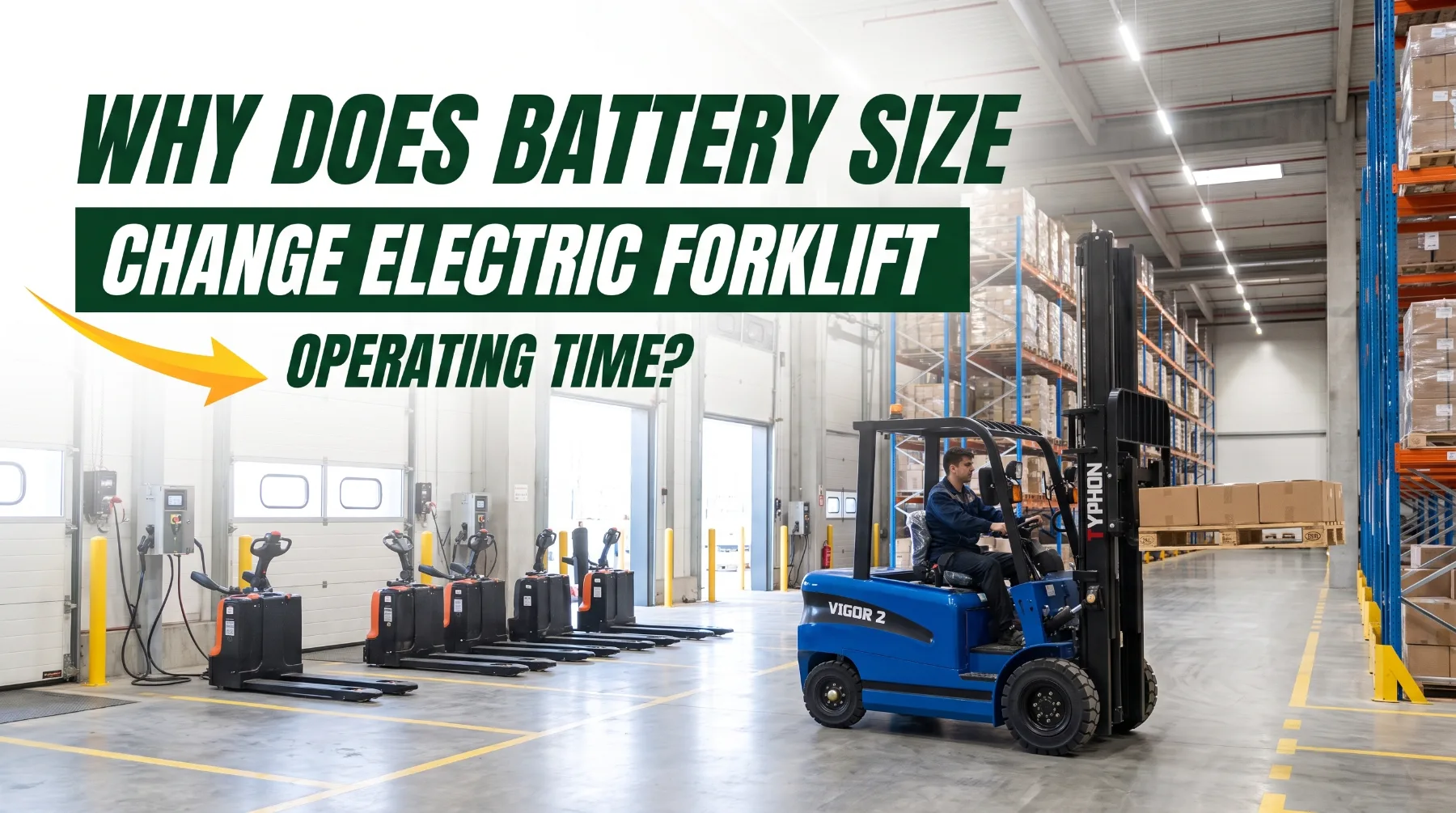
Runtime is one of the most important factors in determining whether an electric forklift can complete a full shift or needs to stop for charging. Yet buyers often focus on lift height, load capacity, and mast type while treating the battery as a standard component that simply comes with the truck. That can lead to a poor match between the forklift and the work. Battery capacity, measured in amp-hours (Ah) or kilowatt-hours (kWh), determines how much electrical energy the truck can store and therefore how long it can operate between charges.
A larger battery generally provides more available energy, but actual runtime depends on more than battery size. Load weight, travel distance, lift frequency, operating intensity, battery chemistry, and charging practices all affect how quickly that stored energy is used. The right approach is to size the battery around your real duty cycle and shift requirements, rather than relying on a best-case runtime figure from the specification sheet.
How Battery Capacity Translates to Operating Time
Start with what capacity actually measures. A forklift battery’s size is expressed two ways: amp-hours (Ah), which describe how much current the battery delivers over time, and kilowatt-hours (kWh), which describe total energy storage once voltage is factored in. The kWh figure is the one that maps most cleanly to runtime, because it represents the full pool of energy available to do work.
Think of the battery as a fuel tank. A larger tank holds more fuel, so the machine runs longer between fills. A forklift drawing a steady average current from a larger amp-hour battery simply has more reserve to pull from, which stretches the hours between charges. Double the usable capacity, and in rough terms you double the operating time under the same workload.
One caution keeps this from being pure arithmetic: usable capacity isn’t the same as rated capacity. Lead-acid batteries, in particular, shouldn’t be discharged past roughly half their rating without shortening their life, so the energy you can safely use is smaller than the number on the label. Plan around usable energy, not the headline figure.
How Load Weight and Lift Frequency Drain the Battery Faster
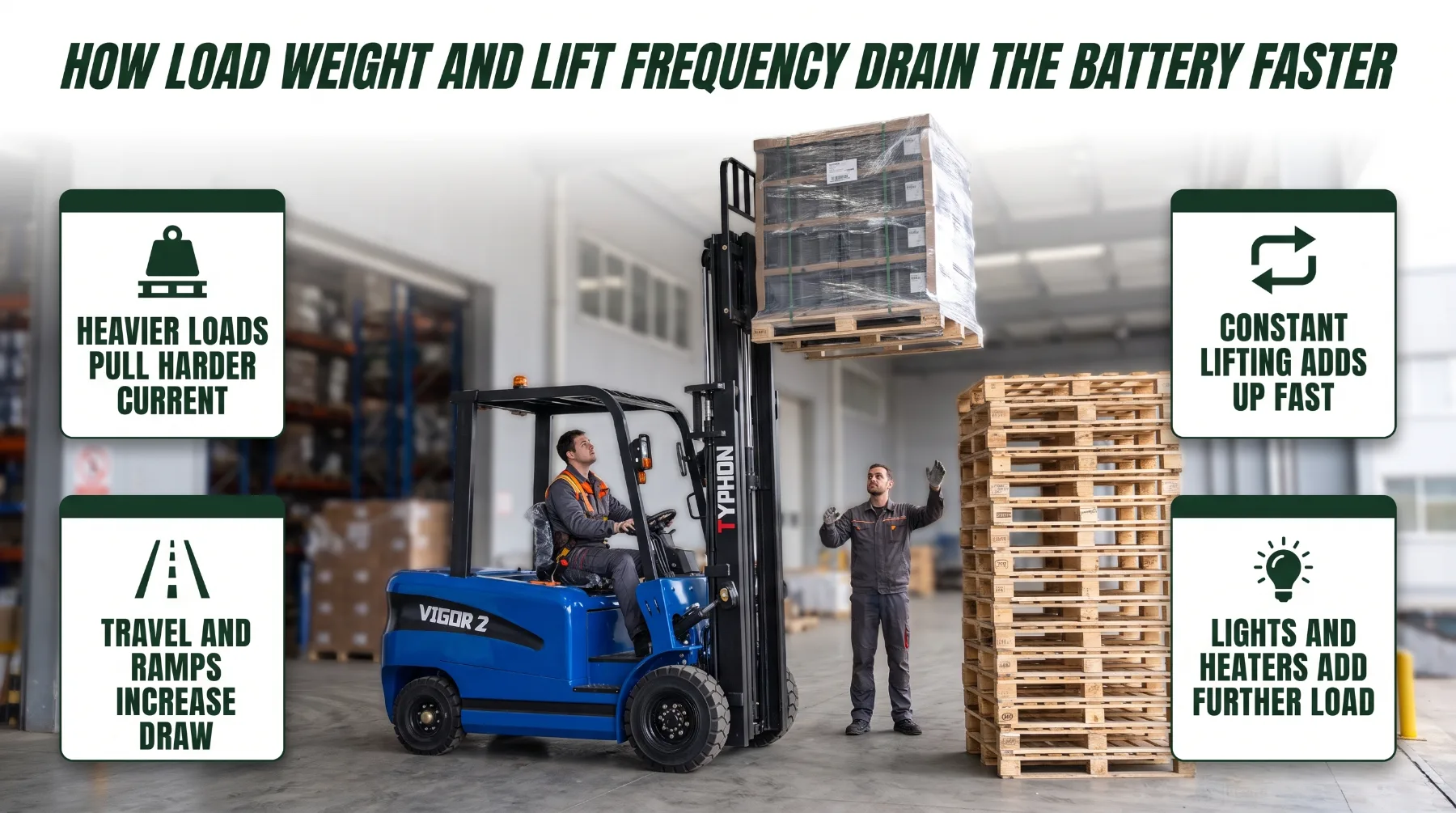
Capacity tells only half the story; the other half is how fast the truck empties that tank. Every lift, every travel movement, and every hydraulic function pulls current from the battery, and heavier work pulls harder. A forklift moving maximum-rated pallets all day draws far more energy per hour than one shuttling light, occasional loads.
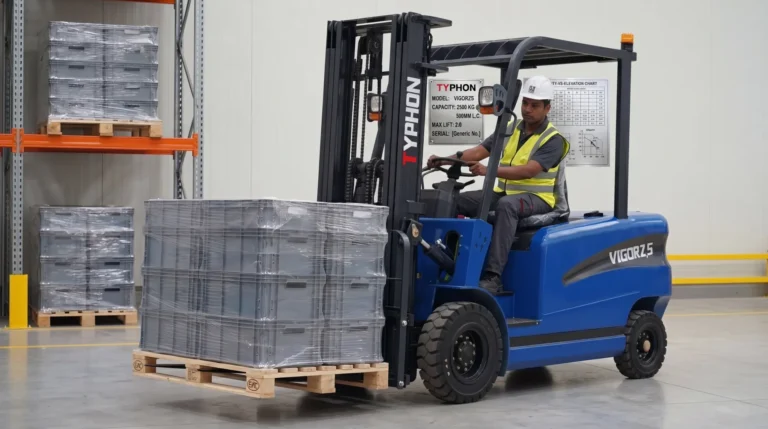
Load weight is the biggest variable. Raising a heavy pallet demands high hydraulic pressure, and generating that pressure draws a heavy current spike from the battery. Do it once and the drain is trivial; do it hundreds of times across a shift and the cumulative energy adds up quickly. Two identical forklifts with identical batteries can post very different runtimes purely because one handles heavier loads.
Lift frequency compounds the effect. A forklift used for constant lifting, stacking, and retrieving keeps its hydraulic system working for much longer periods than one used for occasional lifts, increasing overall energy demand. Travel distance, ramp grades, and accessories such as lights and heaters add further loads, so machines working continuously or under heavier conditions require greater energy capacity.
Takeaway: the same battery delivers fewer hours under heavy loads and constant lifting, so runtime depends as much on how hard the truck works as on how much energy it stores.
How Duty Cycle and Shift Length Drive Battery Sizing Decisions
Sizing a battery starts with understanding the forklift’s actual duty cycle, including the loads it handles, how often it lifts, how long it operates, and how much idle time it has during a shift. A light-duty operation with smaller loads and frequent breaks uses energy more gradually, while a forklift working continuously with heavy loads can drain its battery much faster. The battery should therefore be sized around the machine’s real working demands rather than an average that may not reflect the busiest parts of the shift.
Shift length is the second half of the equation. A single eight-hour shift with normal breaks asks far less of a battery than two back-to-back shifts, or a demanding sixteen-hour day where the truck barely rests. The rule of thumb many operations follow is straightforward: the battery should carry the truck through a full working period without forcing an interruption to swap or recharge.
Consider three common patterns and what they demand:
- Single light shift: a moderately sized battery comfortably covers the hours with reserve to spare.
- Single heavy shift: high loads and constant lifting call for a larger battery to reach the end of the day.
- Multi-shift operation: running around the clock requires either a very large battery, a battery-swap plan, or a charging strategy built into the workflow.
Underestimate the duty cycle and you strand a truck mid-shift; overestimate it and you pay for capacity and weight you never use.
Takeaway: match battery size to your heaviest realistic shift, accounting for both how hard the truck works and how long it must run before it can charge.
Lead-Acid vs. Lithium-Ion: Size and Runtime Differences
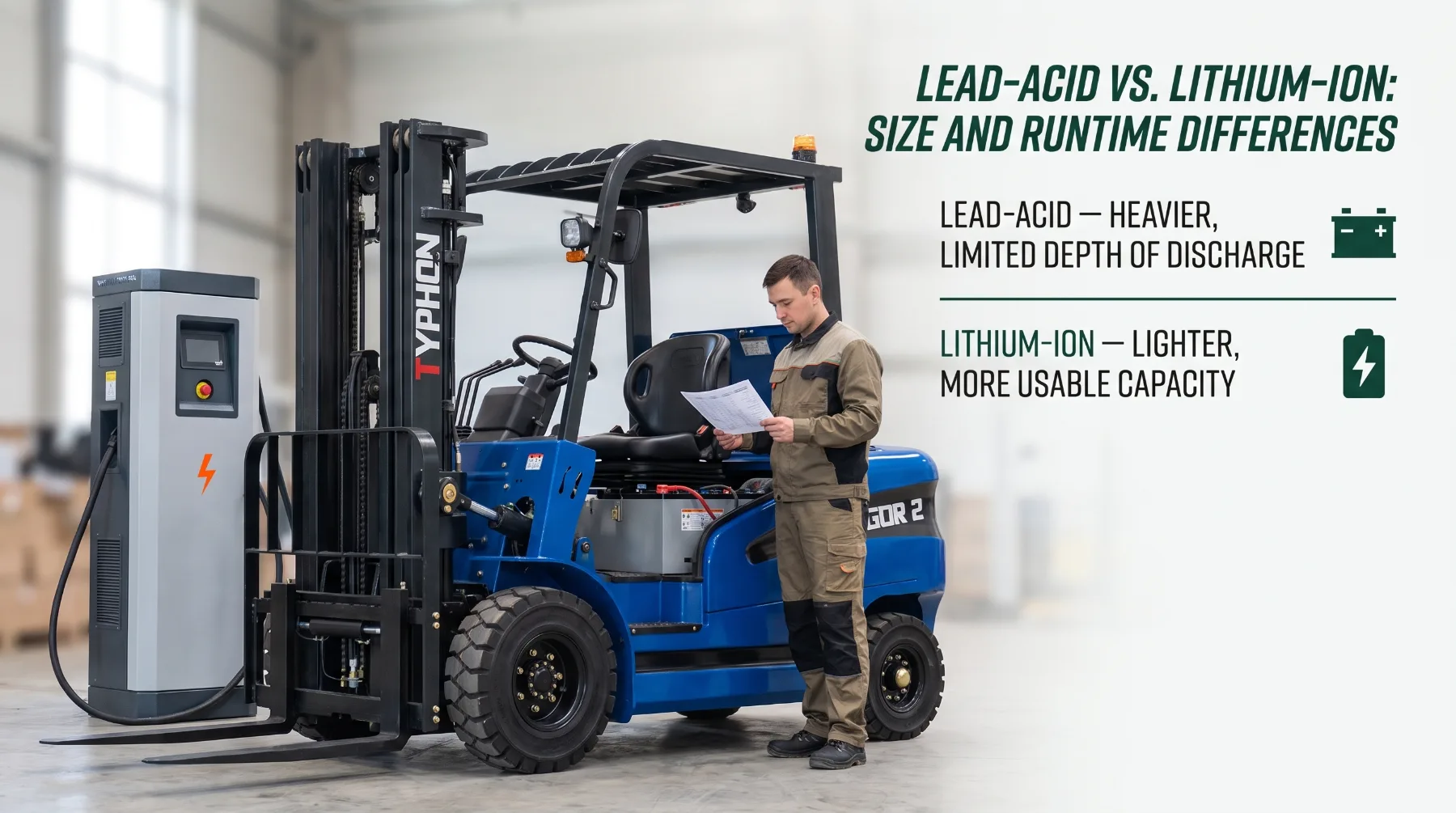
Battery chemistry significantly affects usable capacity and charging behavior. Traditional lead-acid batteries have long been used in forklifts, but they typically should not be deeply discharged because repeated deep cycling can shorten battery life. They also require longer charging and cooling periods, making frequent opportunity charging less practical. Lithium-ion batteries can generally be discharged more deeply, allowing a greater portion of their rated capacity to be used during operation. They also maintain a more consistent voltage as the charge level drops, helping the forklift maintain steadier performance throughout the shift.
The size and weight comparison matters too. Lead-acid batteries are heavy, and that weight often doubles as counterweight in the forklift’s design, so switching chemistries isn’t always a simple swap. Lithium-ion packs more usable energy into less space and weight, but the truck’s ballast and battery compartment have to be engineered for it. The practical upshot: a smaller-rated lithium battery can outlast a larger-rated lead-acid one, so compare usable energy and real runtime rather than rated capacity alone.
Takeaway: lithium-ion delivers more usable runtime per rated kWh and charges on your terms, while lead-acid locks away half its capacity and demands rest, so chemistry shapes runtime as much as size does.
How Opportunity Charging Changes the Equation
Charging strategy can change the battery sizing decision. Opportunity charging means topping up the forklift battery during natural breaks in the workday, such as lunch, shift changes, or short periods of downtime, instead of waiting for the battery to run low before starting a long charging cycle. When used correctly, this approach can help a forklift operate through longer shifts without requiring a full battery swap.
This changes how much battery capacity is needed. Rather than sizing the battery to complete an entire shift on one charge, you can size it to cover the working periods between charging opportunities. A forklift that receives short charges during regular breaks can continue operating throughout the day without needing the same total capacity as a truck that relies on a single full charge. In this way, opportunity charging can extend operating time by replenishing energy during planned downtime.
Battery chemistry determines how well this strategy works. Lithium-ion batteries are well suited to opportunity charging because they can generally accept frequent partial charges without the same limitations associated with deep cycling and long charging periods. Lead-acid batteries are less suited to frequent partial charging because they typically require regular full charging and appropriate charging practices to maintain battery life, along with cooling time after charging. As a result, opportunity charging is generally better matched with lithium-ion systems.
Takeaway: Opportunity charging can reduce the battery capacity needed for a full working day by replenishing energy during breaks, but the strategy works best with a battery chemistry designed to handle frequent partial charging.
Conclusion
Battery size is the foundation of a forklift’s operating time because usable capacity determines how much energy is actually available, while load weight, lift frequency, shift length, and duty cycle determine how quickly that energy is consumed. The right battery should be sized for the heaviest realistic shift with enough reserve to account for battery aging and changing workloads, while lithium-ion can provide more usable energy and support opportunity charging compared with traditional lead-acid systems. Before choosing a battery, profile the fleet’s real workload, map daily shift patterns, determine the charging strategy, and verify expected runtime with actual operating data so the forklift can deliver reliable, uninterrupted performance throughout its working life.
Frequently Asked Questions
How do I calculate how long a forklift battery will last on one charge?
Start with the battery’s usable energy in kilowatt-hours, not its rated capacity, since lead-acid batteries safely deliver only about half their rating. Then estimate the truck’s average energy draw per hour based on your loads, lift frequency, and travel. Dividing usable energy by hourly draw gives a working estimate of runtime. Because real draw varies with the work, the most reliable answer comes from tracking actual runtime on your floor under genuine workloads rather than relying on a calculation alone.
Why does my forklift run out of charge faster on some days than others?
Runtime tracks how hard the truck works, not just how much energy the battery stores. Days with heavier loads, more frequent lifting, longer travel distances, ramp work, or heavy accessory use all pull more current and drain the battery faster. The same battery that comfortably covers a light day can fall short on a heavy one. If runtime consistently falls short on your busiest days, the battery is likely undersized for your true peak duty cycle.
Is a lithium-ion battery worth it for extending forklift operating time?
For many operations, yes. Lithium-ion delivers more usable energy per rated kilowatt-hour because it tolerates deeper discharge, so a lithium battery often outlasts a larger-rated lead-acid one on a single charge. It also accepts fast, frequent opportunity charging without damage, letting a smaller battery cover long or multi-shift days by topping up during breaks. The tradeoffs are a higher upfront cost and the need to engineer the truck’s counterweight and compartment for the lighter pack, so weigh those against your hours and charging plan.