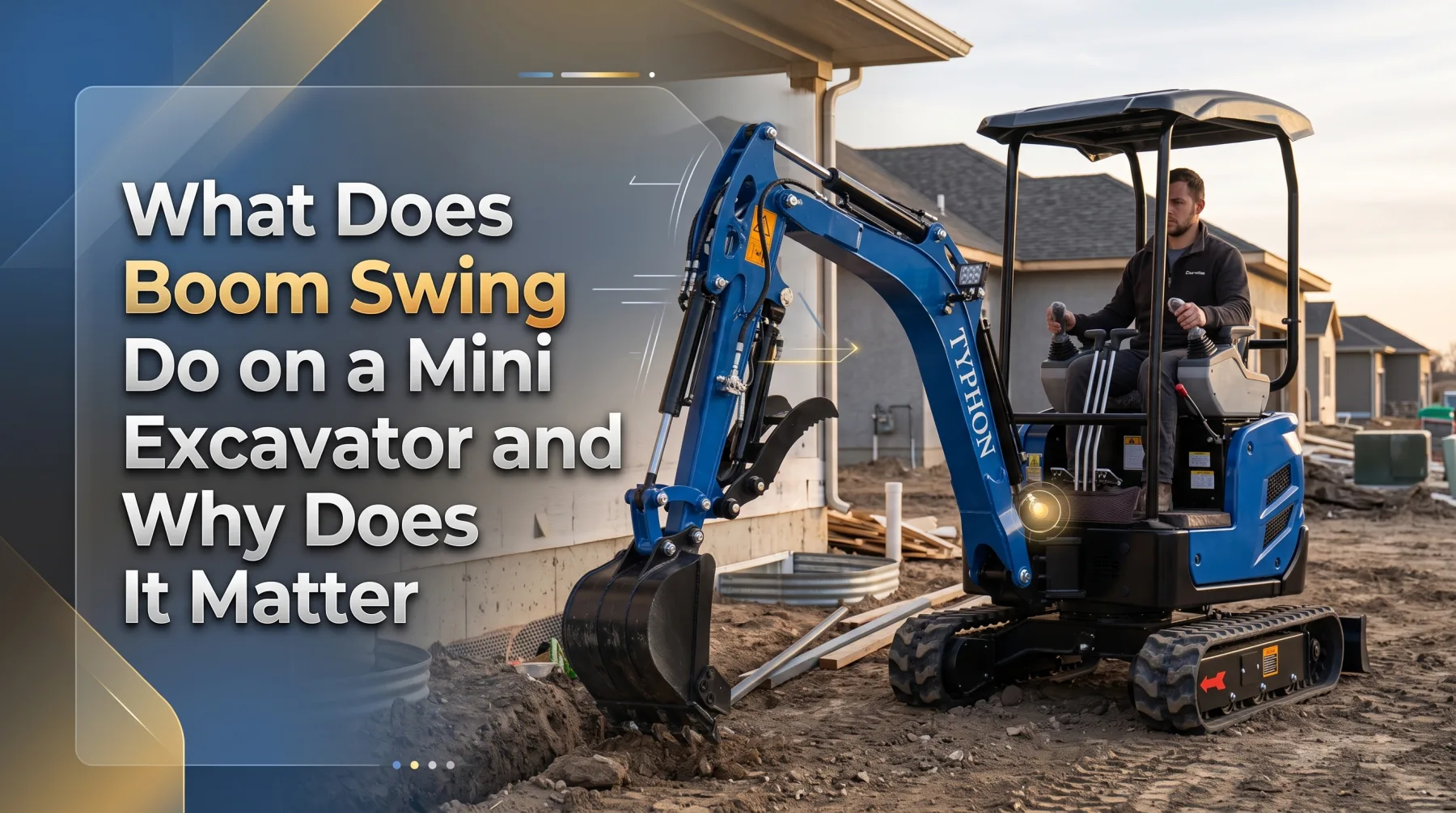
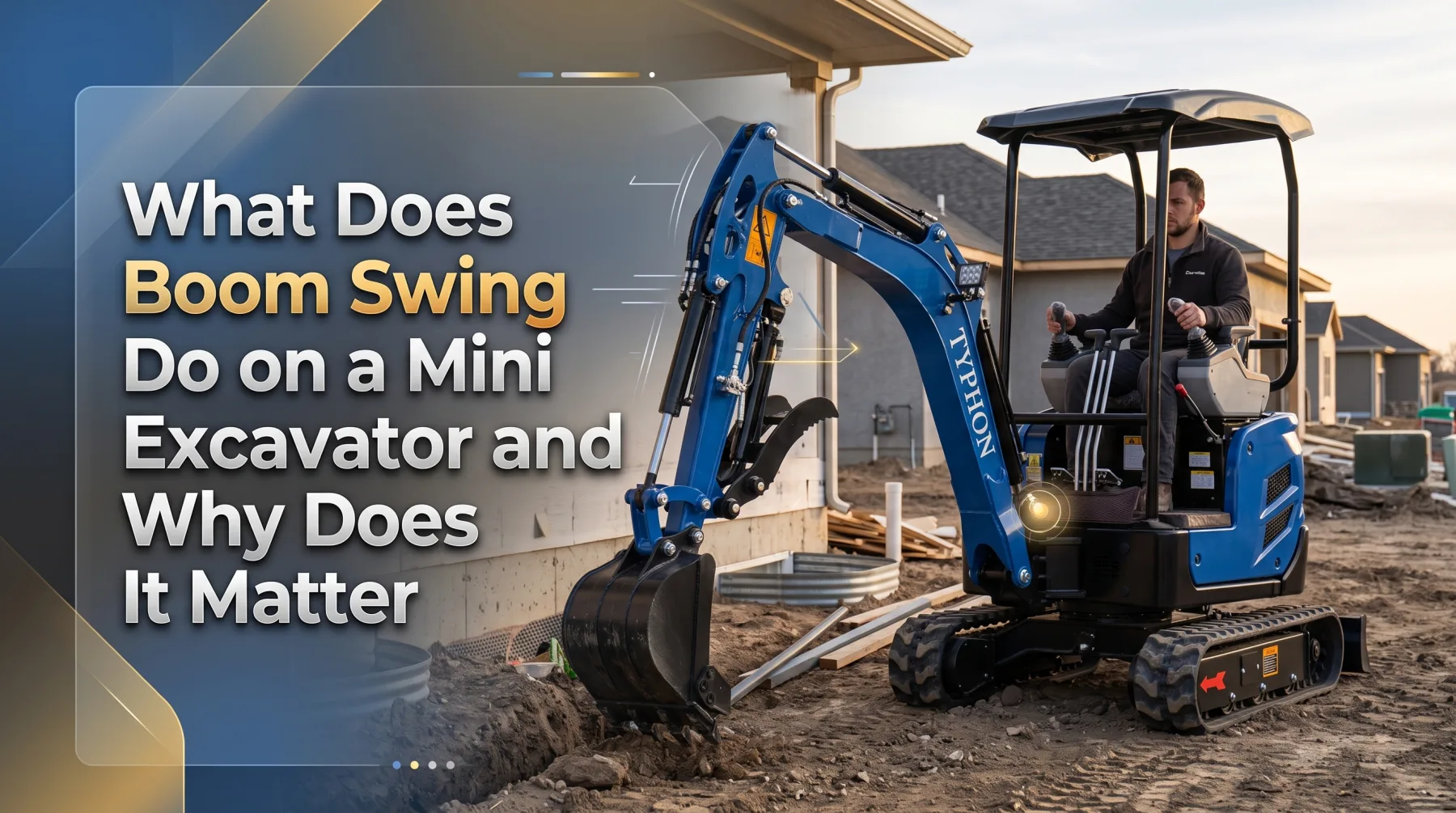
You pull up to a narrow side-yard trench, a fence on one side and the house foundation on the other. The line has to run straight along the wall, but there's no room to angle the whole machine toward it. On a fixed setup, you'd be repositioning the tracks every few feet, fighting for a clean approach the whole way. Instead, you swing the boom to the side, line the bucket up parallel to the wall, and dig the trench without ever twisting the machine off its path.
That ability to offset the digging line without moving the tracks is a boom swing, and it quietly separates a mini excavator that struggles in tight spots from one that works them with ease. If you're weighing which machine fits your jobs, our guide to choosing the right compact excavator pairs well with this one.Understanding boom swing operation helps operators see how this feature improves offset digging along walls, around obstacles, and in areas where repositioning the machine is difficult. It also reveals how boom swing can influence trenching efficiency, jobsite productivity, and long-term machine performance when properly maintained. By the end, you'll understand why this capability has become a valuable feature on many compact machines used for construction and landscaping projects.
What Boom Swing Actually Does on a Mini Excavator
Before you can judge how much this feature matters, you need a clear picture of what it does. Boom swing lets the entire boom pivot left or right from the machine's centerline, independent of the house and tracks, so the digging line shifts without turning the machine.
The Mechanics Behind the Swing
Boom swing works through a pivoting connection at the base of the boom, driven by a dedicated hydraulic cylinder. When you activate it, the cylinder pushes the boom to one side, angling the whole digging arm off the machine's centerline. The tracks and cab stay put while the bucket moves to a new working line.
This is different from the machine's main slew, which rotates the entire upper structure. Boom swing moves only the boom, offering fine sideways adjustment for the digging end alone. That distinction matters, because it's what lets you fine-tune your approach in spaces too tight for the whole machine to turn.
Why the Feature Exists
Mini excavators earn their keep in confined spaces where full-size machines can't fit. Boom swing exists to extend that advantage, letting the machine dig close to walls, fences, and foundations that would otherwise block a straight approach. It turns awkward, obstructed sites into workable ones.
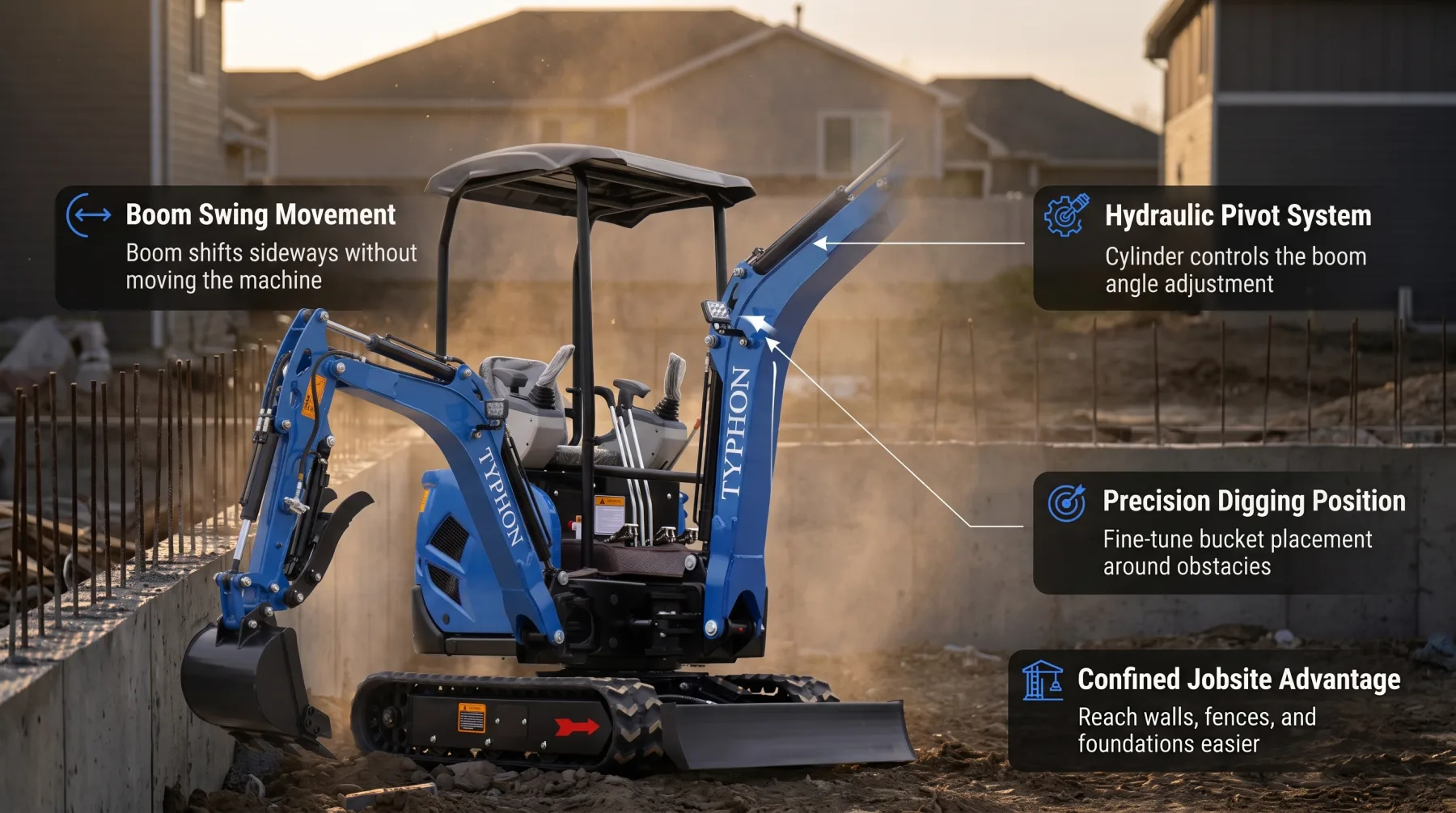
Without it, an operator has to reposition the tracks constantly to line up each cut, which eats time and risks disturbing the ground around the dig. Boom swing removes much of that shuffle, keeping the machine stable while the bucket reaches the line it needs. That's the whole point: more reach and flexibility from a small, nimble platform.
Takeaway: Boom swing pivots the boom left or right from centerline while the tracks stay planted, giving a mini excavator the sideways reach to work close to obstacles without constantly repositioning the machine.
How Boom Swing Powers Offset Digging Along Walls and Obstacles
Now that you know how it moves, let's look at where boom swing truly earns its place: digging parallel to fixed obstacles. This is the work that separates a capable mini excavator from one that fights you every foot of the way.
Digging Close to Walls and Foundations
The most valuable use of the boom swing is trenching right alongside a wall or foundation. By offsetting the boom, you point the bucket parallel to the structure and dig a straight line without angling the tracks toward it. The machine sits square and stable while the bucket does precise work along the edge.
This matters for utility runs, footing drains, and any line that has to hug a building. A fixed machine would force you to work at an angle or reposition repeatedly, leaving an uneven cut. With boom swing, you keep a clean, straight trench right where the plans call for it, close to the structure and true to the line.
Working Around Fixed Obstacles
Job sites are full of things you can't move: property fences, existing utilities, trees, and curbs. Boom swing lets you shift the digging line around these obstacles while keeping the machine on solid, level ground away from the edge. You reach past or beside the obstruction without having to perch the tracks in a bad spot.
This keeps the operator safer and the machine steadier. Instead of positioning the tracks near a trench edge or an unstable shoulder to reach an awkward line, you plant the machine on firm ground and swing the boom to the work. Independent job-site safety resources on trenching and excavation practices reinforce why keeping the machine back from unstable edges matters. The result is precise digging in tight, obstacle-filled spaces that would stall a fixed setup.
Takeaway: Boom swing lets a mini excavator dig parallel to walls and around fixed obstacles while the machine stays square on stable ground, delivering clean, precise cuts in confined spaces without risky repositioning.
How Boom Swing Shapes Trenching Speed and Productivity
Beyond reaching tight spots, boom swing changes how efficiently a mini excavator gets through everyday work. The time it saves adds up across a shift, and understanding where those gains come from helps you see its real value.
Fewer Repositioning Moves
Every time an operator repositions the tracks to line up a cut, the digging stops. Boom swing cuts down on that shuffle by letting the bucket reach a new line without moving the machine. You dig longer stretches from a single, stable setup, and the work flows instead of stopping and starting.
Those saved moves compound fast. On a long trench alongside a structure, avoiding a reposition every few feet can shave real time off the job and reduce wear on the tracks and undercarriage. Steady, continuous digging is simply faster and easier on the machine than a constant cycle of set, dig, and shift.
Cleaner Work in Confined Layouts
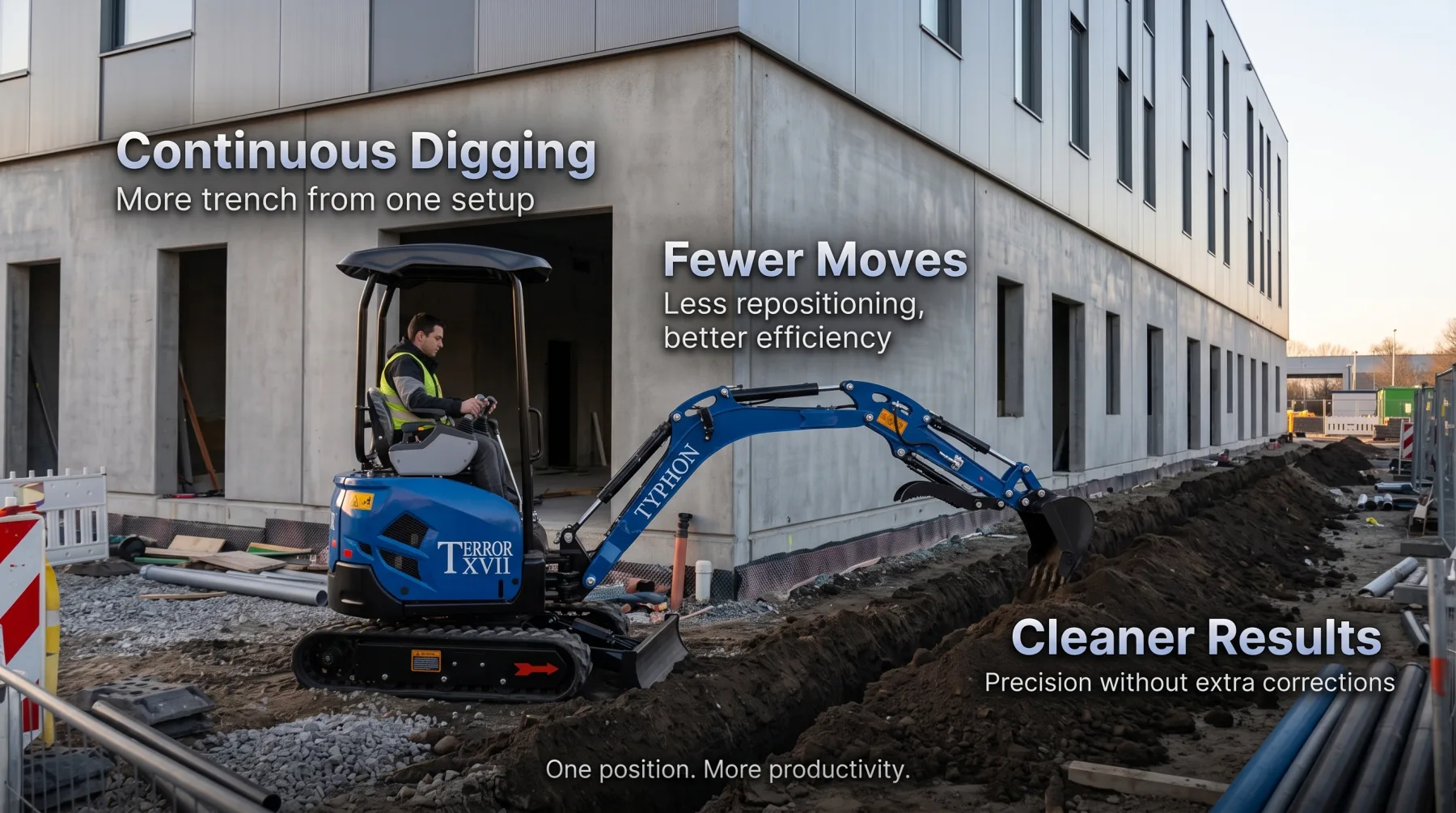
Productivity isn't only about speed; it's about doing the job right the first time. Boom swing helps an operator hold a straight, consistent line in tight layouts, which means less time spent correcting an uneven trench or cleaning up a wandering cut. Precision the first time is productivity you don't have to redo.
The feature also opens up sites that would otherwise need hand digging or a smaller tool. Where a fixed machine can't reach a line cleanly, boom swing often lets the excavator handle it directly, saving a whole round of manual work. For contractors comparing machines built for tight urban and residential jobs, offset capability can matter as much as digging depth.
Takeaway: Boom swing reduces repositioning, keeps digging continuous, and helps operators hold clean lines in confined layouts, so the machine finishes tight, obstacle-heavy work faster and with less rework.
How to Keep the Boom Swing System Working Reliably
Boom swing is only an advantage when it works smoothly, and like any hydraulic system, it rewards regular care. This is the part most within your control, and it protects both the feature and the machine that depends on it.
What Wear Looks Like in the System
The boom swing system relies on a hydraulic cylinder, a pivot bushing or pin, and the seals and lines that feed it. Over time, the pivot can develop play, seals can wear, and fluid can slip past internally. The first signs are usually subtle: a swing that drifts back on its own, slow or jerky movement, or side-to-side slop at the pivot.
Left unchecked, small problems grow. A worn pivot pin accelerates wear on the surrounding parts, and a leaking cylinder gradually loses the power to hold the boom offset under load. Catching these early keeps a minor service from turning into a larger repair that pulls the machine off the job.
Simple Habits That Protect Performance
Keeping the system dependable comes down to consistent, straightforward care. Build these habits into your routine
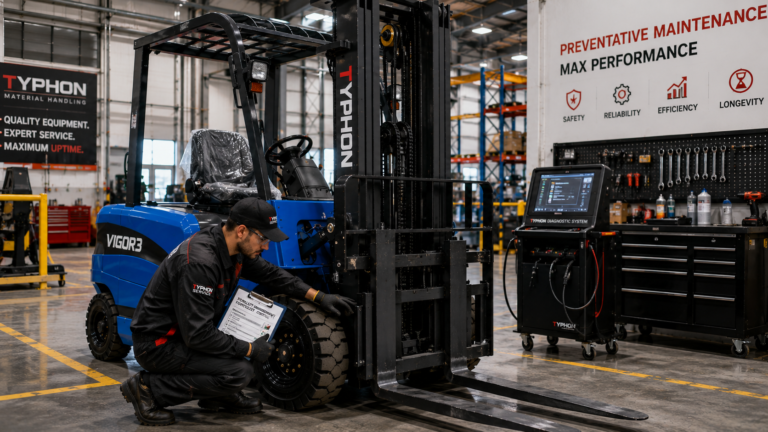
Grease the pivot points on schedule, since dry pins and bushings wear quickly under load.
Watch for drift by swinging the boom to one side and checking whether it holds instead of creeping back.
Inspect the cylinder and lines for leaks, seepage, or damage around the swing mechanism.
Listen and feel for slop during operation, addressing any looseness at the pivot before it worsens.
Follow the manufacturer's service intervals for the hydraulic system and swing components.
Early attention is always cheaper than a mid-job breakdown. A machine with a well-maintained swing system, clean fluid, and dependable parts support keeps its full flexibility available whenever a tight, awkward site demands it. That reliability is what separates a machine you can count on from one that lets you down at the worst moment.
Takeaway: The boom swing system rewards regular greasing, leak checks, and attention to drift and pivot play, so consistent care keeps the feature smooth and dependable exactly when confined work needs it most.
Frequently Asked Questions
Is the boom swing the same as the machine rotating?
No. The machine's slew rotates the entire upper structure, cab and all, on the track base. Boom swing pivots only the boom left or right from the centerline, moving the digging end while the cab and tracks stay put. Slew is for turning to dump or reposition; boom swing is for fine sideways offset so you can dig close to walls and around obstacles without twisting the whole machine.
When do I really need a boom swing on a job?
It shines whenever you have to dig parallel to a fixed obstacle: trenching along a foundation, running a line beside a fence, or working next to existing utilities and curbs. It's also valuable on tight residential and urban sites where there's no room to keep repositioning the machine. If your work is mostly open ground with plenty of space, you'll use it less, but for confined and obstacle-heavy jobs it's hard to do without.
Does using a boom swing make the machine less stable?
Offsetting the boom does shift the machine's load to one side, so stability deserves attention, especially when lifting or working on a slope. The key is keeping the tracks on firm, level ground and staying within the machine's rated limits. Used sensibly, boom swing actually improves safety by letting you keep the machine back from unstable trench edges rather than perching the tracks in a risky spot to reach a line.
How do I know the boom swing system needs service?
The clearest signals are drift and slop. Swing the boom to one side and see if it holds; if it creeps back on its own, the cylinder or seals may be worn. Side-to-side looseness, slow or jerky swing movement, and any visible leaks around the cylinder or lines are other warning signs. Regular greasing and prompt attention to these symptoms keep the system tight and dependable.
Conclusion
Boom swing is the feature that lets a mini excavator do what its size promises: work cleanly in tight, obstacle-filled spaces. By pivoting the boom off the centerline while the tracks stay planted, it lets you dig parallel to walls and foundations, reach around fences and utilities, and hold a straight line without constantly repositioning the machine. That translates into fewer wasted moves, faster trenching, and precise cuts on sites that would stall a fixed setup, all from a stable, safe position on firm ground.
Experienced operators understand that boom swing is more than just an extra function; it is a practical advantage when working around obstacles, structures, and limited access areas. Keeping the swing components properly maintained, checking for hydraulic issues, and monitoring movement accuracy help ensure the system performs when precision matters most. Before starting a project with challenging layouts, consider how often you need to adjust your digging position without moving the machine and whether your equipment can handle those demands efficiently. Choosing the right setup with reliable swing performance can make daily tasks smoother and help operators achieve more consistent results in complex working conditions.